
Cut to 2026, that equation is changing.
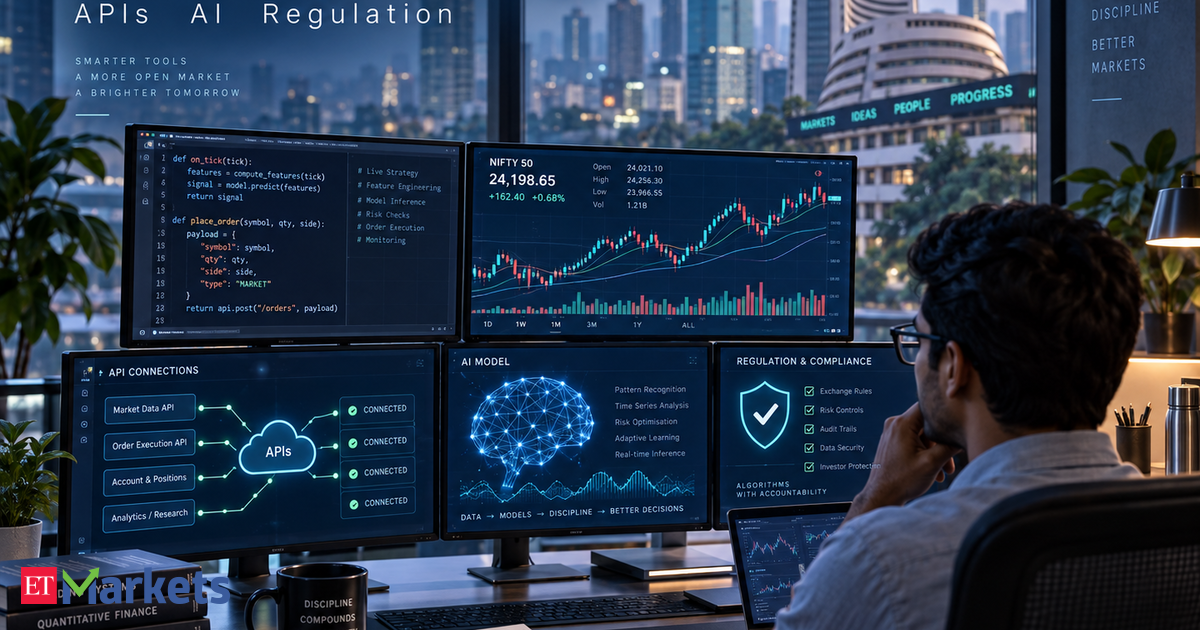
The combination of broker APIs, cloud infrastructure, affordable market data, no-code and low-code platforms, AI-assisted coding and a clearer regulatory framework is bringing systematic trading closer to the retail investor. What once required an institutional technology stack can increasingly be accessed through a laptop, a broker account and a few thousand rupees a month.
But experts say the real change is not that algo trading has suddenly become easy. Rather, the infrastructure behind sophisticated trading is being packaged into tools that ordinary traders can understand and use.
From institutional infrastructure to broker APIs
According to Rakesh Pujara, Founder and Managing Partner, Compounding Wealth Advisors LLP, three major developments have converged to bring algo trading into the retail mainstream.

The first is access to infrastructure that was once largely restricted to institutions and proprietary trading firms. Broker APIs have made it possible for traders to connect their strategies directly to trading systems, while the regulatory framework has provided greater structure around retail participation.
“Infrastructure that used to sit exclusively with institutions and prop desks is now available over an API from any broker,” Pujara said, pointing to the evolution of broker-led API access and the formalisation of retail algo trading.The significance of this shift is easy to underestimate. A decade ago, systematic trading could mean specialised servers, expensive infrastructure and significant capital. Today, much of the plumbing can be accessed through a retail brokerage ecosystem.
Prashant Shah, CEO & Co-Founder of Definedge Securities, sees the same trend playing out across the technology stack. Market data, APIs, cloud infrastructure, backtesting engines and strategy-building platforms have all become more accessible.
The result, he said, is that traders no longer have to recreate an institutional technology stack from scratch. “Sophisticated infrastructure is increasingly being packaged into simpler tools,” Shah said.
That packaging could prove to be one of the biggest catalysts for retail adoption.
AI is removing the programming barrier
The second big change is artificial intelligence.
Historically, a trader with an idea for a systematic strategy needed to translate that idea into code, test it against historical data, troubleshoot errors and then build an execution system. That process could take weeks or months and often required specialist programming skills.
AI is compressing that learning curve.
Pujara said AI-assisted strategy builders and low-code platforms have significantly reduced the time required to move from an idea to a working prototype. A trader may no longer need to write every line of execution logic themselves or have an extensive understanding of market microstructure before testing a strategy.
Mehta takes the argument a step further. According to Vishal Mehta, CMT, Founder of vishalmehtacmt.com, the trader increasingly does not need to be a programmer at all.
“Drag-and-drop tools” and AI-generated code mean the technical heavy lifting can increasingly be outsourced to software, he said. The trader’s job, therefore, shifts towards defining the rules: when to enter, when to exit, how much capital to deploy and how to manage risk.
That could make algo trading particularly attractive to a generation of retail traders already comfortable with technology and accustomed to using app-based investment platforms.
But there is an important distinction: removing the coding barrier does not remove the strategy-development barrier.
A poorly designed strategy can still lose money—only now it may do so faster and more consistently.
The cost of going systematic has collapsed
Cost is another major reason behind the retail algo boom.
The economics of computing have changed dramatically. Cloud servers, data feeds and testing infrastructure that once demanded meaningful upfront investment can now be rented as a service.
Mehta estimates that traders can access much of the required infrastructure for a few thousand rupees a month.
Pujara also points to the collapse in infrastructure costs as an underappreciated driver. Cloud computing and market-data access have brought down the cost of running systematic strategies compared with what traders would have faced a decade ago.
This matters because algo trading does not necessarily require the kind of capital that was once associated with institutional trading infrastructure.
The barrier has moved from “Can I afford the technology?” to “Do I have a strategy worth automating?”
Regulation is turning a grey area into a formal ecosystem
Technology and falling costs alone, however, do not explain the timing of the retail algo opportunity. Regulation is playing an equally important role.
SEBI issued its framework for safer participation of retail investors in algorithmic trading in February 2025, with the framework subsequently being operationalised through the exchange ecosystem. The new framework provides greater clarity around how retail algo orders are handled, including responsibilities of brokers and the tagging and approval of algorithms.
Mehta believes this regulatory clarity is a critical piece of the puzzle.
“Earlier it was a grey area. Now it’s official,” he said, referring to the formal framework governing retail algo participation.
Shah similarly highlighted the emergence of exchange procedures and empanelled algo providers as an important development. In other words, retail algo trading is moving away from an informal ecosystem towards a more structured market infrastructure.
That could increase confidence among traders who were previously hesitant to automate their trades because of uncertainty around technology, brokers or regulatory oversight.
India’s expanding retail investor base adds fuel
There is also a much larger pool of potential users today.
Shah pointed to NSE’s 12.9 crore registered investors as of March 2026 as evidence of how dramatically India’s retail investment ecosystem has expanded.
Of course, registered investors should not be equated with potential algo traders. Most retail investors are still long-term investors, mutual fund investors or conventional stock traders. But the underlying addressable market for sophisticated trading tools is undeniably much larger than it was a decade ago.
As more investors become comfortable with derivatives, APIs, quantitative tools and digital trading platforms, systematic strategies could become the next layer of evolution for a section of active traders.
The bigger shift: from trading manually to trading by rules
Perhaps the most important change is psychological rather than technological.
Retail traders have traditionally relied heavily on discretion—watching charts, reacting to news, making decisions under pressure and sometimes changing their rules midway through a trade.
Algo trading offers a different proposition: define the rules first and let the system execute them.
That can reduce some of the emotional interference that often accompanies trading. But it can also create a false sense of precision. Automation does not make a strategy profitable; it simply ensures that the strategy is executed according to its rules.
The democratisation of algo trading, therefore, should not be confused with the democratisation of alpha.
As Pujara, Shah and Mehta’s views collectively suggest, the technology barrier is falling rapidly—but the investment and risk-management challenge remains.
The retail trader now has access to tools that were once the preserve of institutions. The next question is whether they can use those tools with the discipline, testing and risk controls that institutions have spent decades developing.
(Disclaimer: Recommendations, suggestions, views, and opinions given by experts are their own. These do not represent the views of the Economic Times)