
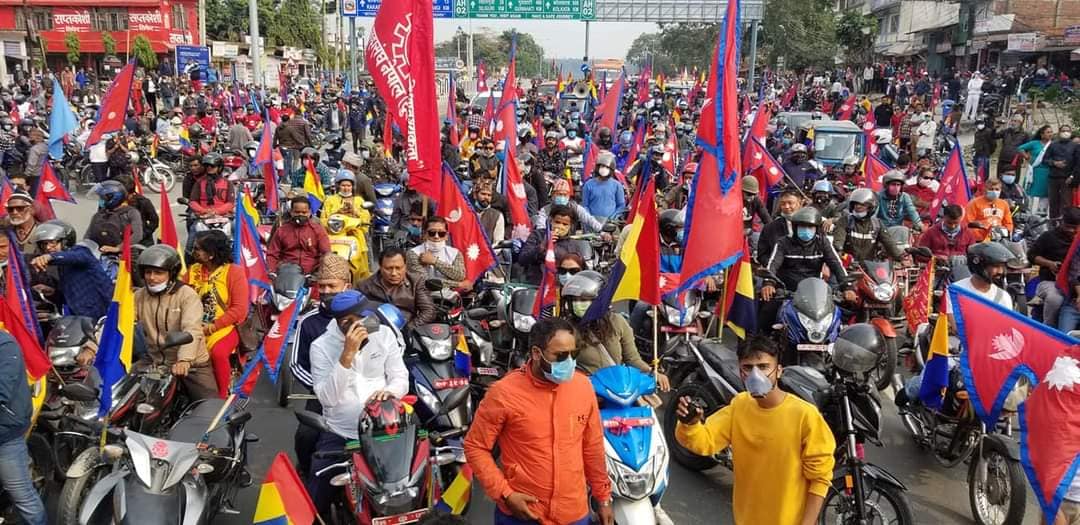
From the 1950s onward, almost all political parties in Nepal have marched under the banner of socialism—some treating it as a stepping stone to communism, others as the ultimate goal of liberal democracy. From the Nepali Congress’s early call for democratic socialism to the communist parties’ countless versions of people’s socialism, all promised justice through state control. Both groups opposed the monarchy, yet remained deeply hostile toward each other.
From Campus Battles to National Paralysis
I witnessed this firsthand in the mid-1970s and early 1980s, when I was a student and Nepal’s campuses had become battlegrounds for students representing these two camps—the communist and the liberal-democratic—often clashing, sometimes violently. Looking back, I now realize how misplaced that struggle was, and how deeply it depleted our ability to think freely. What began as a student struggle of ideas hardened into a national pattern of failure that endures to this day.
Over time, that struggle changed its form: the contest has shifted to a new question—who can claim to be the greater socialist? The battle now plays out on every election platform, in every
legislature, and echoes through our collective conscience. Inserting the word socialism—or even communism—into a party’s name has become a ritual of legitimacy. To question it is to risk being branded a capitalist or neoliberal—labels considered inherently heretical and anti-national.
It is therefore unsurprising that this ideological fixation eventually found its way into the Constitution of 2015, which enshrines Nepal as a “socialism-oriented” federal democratic republic. Yet no one can clearly define what that means. Is it full state ownership, a mixed economy balancing market and government, or some vague notion of cooperative control? We get as many answers as there are politicians.
Related story
Transhumanist Ideals: Techno-Libertarianism to Anarcho-Capitali…

The Illusion of Ideological Purity
This confusion is not just semantic—it shapes how political parties think and govern. In the name of socialism, we have discouraged individual ingenuity, entrepreneurship, and the reward for excellence— the spirit of capitalism that drives rising living standards. We mistrust profit, as if wealth creation itself were a moral flaw, forgetting that capitalism’s virtue lies in creating value through enterprise, competition, and accountability. Nor does it end there. Despite lip service, we have abandoned socialism’s moral core—its duty to provide quality education, health care, and social protection. We have privatized opportunity but nationalized inefficiency, ending up with the worst of both worlds: a distrust of enterprise and a neglect of public purpose, producing a society that neither grows nor distributes fairly.
Despite the rhetoric, Nepal in practice is a mixed economy—a blend of socialism and capitalism. Nepal’s failing is that it has blended them incoherently. We allow markets where the state should lead, and state control where the market should work. We privatize public goods and politicize private enterprise. Leaders quote socialist ideals to justify patronage and capitalist slogans to protect monopolies. This confusion has left Nepal with neither the efficiency of markets nor the fairness of good governance—only a fragile economy sustained by remittances and rent-seeking.
A healthy economy is not built by mixing ideologies but by assigning the market and the state to what each does best. The market must drive efficiency—rewarding effort, enforcing contracts, and fostering innovation through competition. The state must secure equity—by making growth and social policies inclusive. For Nepal, the challenge now is not to choose between the two but to restore discipline and purpose to both. Without efficiency, redistribution fails because there is little to share; without equity, growth breeds resentment.
This confusion persists not only among politicians but also among those who see themselves as reformers. Even those who claim to favor markets often misread Nepal’s economic reality. They overlook that healthy markets depend on strong institutions, sound regulation, and fair competition. The socialists, for their part, blame “neoliberalism” for Nepal’s failures—though these failures stem largely from state mismanagement, and Nepal never truly practiced neoliberalism. In truth, both camps misdiagnose the problem. Nepal’s economic malaise arises from a mix of weak state capacity, excessive political interference, and the absence of genuine market competition.
As a result, while Nepal’s neighbors—China and India—surged ahead through pragmatic capitalism, Nepal remained trapped in confusion. Both India and China combined market incentives with state discipline, investing heavily in infrastructure, education, and industry while empowering private enterprise. Nepal, by contrast, built neither a capable state nor a confident private sector. While China and India built confidence in both the state and the market, Nepal built suspicion toward both. The consequences are devastating: mass outmigration, low productivity, and a chronic sense of underachievement.
The Middle Path Forward
Nepal’s choice need not be described as “socialist-oriented,” whatever that may mean. Its challenge is not to decide between capitalism and socialism but to find the right balance. Every successful economy is a hybrid: markets need the state, and the state needs markets. Instead of waging endless and barren debates, Nepal should be asking practical questions: How do we create jobs? How do we make our fields fertile again, our industries hum, our schools teach, and our hospitals heal? How do we allow entrepreneurs to thrive without political patronage? How do we restore hope to the desperate? The answers to these—notideology—will determine whether Nepal prospers.
Our politics, however, remains trapped in nostalgia. The left parades portraits of Marx, Lenin, and Mao to assert its purity; the Congress recites B. P. Koirala’s old ideals; and the royalists, look backward to a corrupt past. Their political gurus lived one to three centuries ago, yet they still call themselves scientific and agile. These old parties, unwilling to learn from failure, cannot address a crisis of their own making. What we see today is their legacy—a vivid reflection of decades of drift and denial.
As the country heads toward another election, the need for a centrist, policy-driven, liberal-democratic alternative with a broad tent could not be clearer. Such a movement must rise above old loyalties and break through the ideological silos that have long divided Nepal’s politics. A party that speaks less of isms and more of outcomes—better schools, accessible healthcare, fair taxation, and a thriving private sector free from political vendetta—could finally earn the confidence of a weary electorate.
Nepal’s democracy does not need more ideology; it needs competence, courage, and coherence.The nations that prospered did not waste decades debating isms; they built systems that delivered. If Nepal can do the same—govern better, invest smarter, and trust its citizens—it can still reclaim its promise.
The same ideological battles that once clouded our campuses have continued to cloud our politics for generations. They must end—only then can Nepal find its way to reason and renewal. Call the system what you will, but what Nepal needs is a system that ensures hope, opportunity, and dignity for every citizen. That vision requires a new political force—bold enough to rise above old loyalties and pragmatic enough to lead Nepal forward.
In the end, Nepal’s revival will begin not with the old or even a new slogan, but with the courage to think anew.
(The author holds a PhD in Economics, and writes on economic issues in Nepal and Canada. He can be reached at acharya.ramc@gmail.com)