
Mōrena. I’m back after a rest and aim to publish on weekdays from now until the end of this election year. I’m also back for this week’s Hoon at 5pm. Here’s the key news today in Aotearoa’s political economy around housing, climate and poverty.
The Reserve Bank hiked the OCR by 25 basis points to 2.75% yesterday, as expected by the ‘wisdom of the crowds’ in financial markets and most economists. It said it had to hike to further suppress employment and wage growth in order to reduce inflation, even though that inflation was caused by the Iranian Revolutionary Guard Corps and Donald Trump, and rate hikes won’t change that fuel inflation one jot.
The central bank kept its forecast track for the OCR broadly unchanged from its May forecast, which surprise many in markets who had expected the track to rise a bit. So the kiwi dollar fell more than half a cent to 58.4 USc and the two-year wholesale ‘swap’ interest rate fell around 10 basis points to 3.69%.
But none of these things matter much in the long run, or even in the short run. This rate hike was unfair, unnecessary and counterproductive, in my view. It should force us to re-examine the framework under which our economy has been run for nearly 40 years, without success. We’ve had long enough to ‘suck it and see.’ We know now. It just sucks. (See more detail, analysis and charts below the fold, and in the video above)
I’ve also just been interviewed on RNZ’s Morning Report. Here’s the link to the interview in full and embedded here:
Elsewhere in the news this morning:
-
Over 200 jobs are at risk in Taranaki after Methanex announced its long-expected final decision to close its gas-to-methanol plant because the gas is running out;
-
Labour, the Greens and Opportunity parties jointly pledged last night to extend the living wage across all workers in the state sector if elected;
-
The edges of the Government’s ‘move-on’ orders are set to be softened as it emerged yesterday all parties want to change the bill to exclude 14-17-year-olds that are homeless; and,
-
There is now no realistic path to stop the climate by warming less than 1.5 degrees, according to a new UN Environment Programme (UNEP) report out overnight.
(I’m opening up today’s email, podcast and video to everyone immediately given the public interest in yesterday’s decision. Thanks in advance to paying subscribers. I’ll do this as much as I can before the election.)
Just as our political economy crawls out from another winter of discontent and stagnation, the Reserve Bank has tightened monetary policy for the second time in two months. It may yet tighten for a third time 10 days before the election. It says it needs to further reduce its stimulus to the economy, event though is already being squeezed by the sinking lid of a Government trying to cut three percentage points of GDP from its spending. The RBNZ portrayed the hike as a little more pain now, rather than even more pain later.
‘This decision reduces the risk that the OCR needs to increase by more later. RBNZ
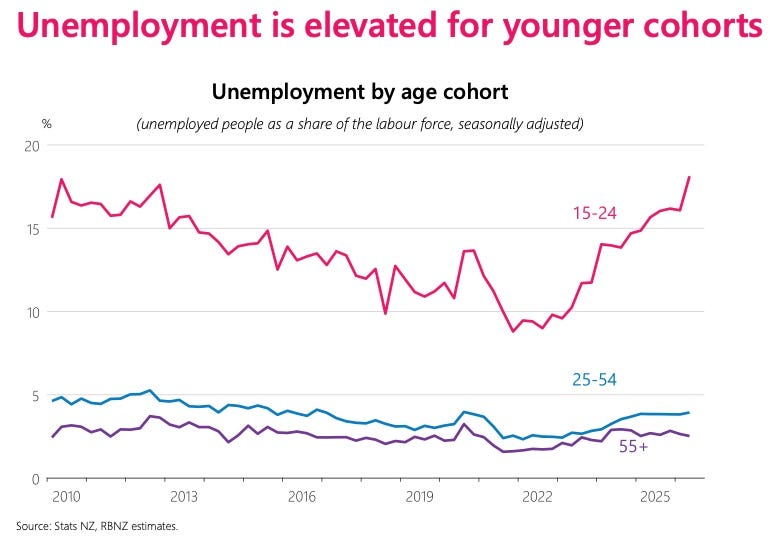
But in my view, this hike will deepen the scars on a generation that grew up and joined the workforce during and after covid. Over a half of all 15-19-year olds in the workforce, 93,000 teenagers, are either out of a job or need more hours of work or jobs. Nearly a quarter of all 20-24-year olds are in the same under-utilised position. More than 4,000 fully unemployed and/or too-sick-to-work 18-19-year olds are about to have their benefits taken away and be forced to live at home. Real average hourly wages are falling. House prices are falling. It doesn’t feel like an economy that is heating up to the point where it’s generating too much inflation from wage increases and demand-drive price hikes. It feels like kicking an economy that’s already down.
Yet the Reserve Bank has just done what 36-years of inflation-targeting independent central banking orthodoxy set it up for and directed it to do. Again, it has used its one blunt instrument, the Official Cash Rate (OCR), to squash employment and economic activity down in order to reduce its one blunt target, the annual inflation rate of the Consumer Price Index (CPI) , to somewhere between 1-3%, from its most-recently measured level of 4.1%. Job done.
We know the orthodoxy well and are all well trained to accept it. The Reserve Bank Act (1989) made the central bank independent and responsible for managing the economy in the short(ish) run to keep inflation low and stable. Achieve this, the theory goes, and everything else will fall into a place of full(ish) employment and prosperity. Consumers will spend because their wages usually grow faster than prices. Investors will invest because they’re confident of making bigger profits in a growing economy. The employment and wage growth will look after itself. Job done.
The other half of the orthodoxy, as is that all the Government needs to do is get out of the way, create free markets, run balanced budgets and reduce public borrowing over the longer run to enable low interest rates to do the work of encouraging private investment in businesses, technology, infrastructure and the rest. The theory is these private investors and households will make better, more efficient and ultimately more productive choices than the Government, in the long run. In theory, all this will allow the Government to be smaller and hand over tax cuts to households and businesses, who will then do an even better and bigger job of growing the economy.
We all know what New Zealand’s major problems are. We don’t have enough healthy and affordable houses to rent and own. We don’t invest nearly enough in building, maintaining and staffing those houses and the hospitals, public transport and schools needed for us all to be healthy, employed and productive. And then we need to invest much, much more in technology, science, our businesses, infrastructure and training to increase our output per hour worked. Only then, will Aotearoa’s people be pulled out of a spiralling cost-of-living crisis by higher wages that can buy much more ample and relatively cheaper goods and services.
We all know what that requires. More investment and employment in housing, hospitals, schools, buses, trains, infrastructure, new companies, bigger companies and more valuable and plentiful goods and services. We know what the long-term failure to do that has meant. We can feel it and see it everywhere, especially this winter. Hospital Emergency Departments have been overwhelmed. Record numbers of people are homeless. At least three froze to death in the open this year. This does not feel like an over-stimulated economy. It feels like an economy labouring under a failed framework designed for 1989, and which has clearly failed.
Instead of supporting the investment, jobs growth and wage growth desperately needed by our political economy, the Reserve Bank has just sent another signal to consumers and businesses to invest and spend less. It even implored the banks yesterday to pass on the 50 basis points of rate hikes to savers as higher term deposit rates, which they have yet to do. It wants the rich to get richer and to save more, rather than spend to employ more the jobless youth.
The way our monetary policy works is just not fair. It punishes the poor, the jobless, the young and the homeless, and it discourages the investment that would improve their situations in the long run. It is tightening policy in a pro-cyclical way in tandem with a fiscal policy tightening, when what we actually need is more jobs and investment.
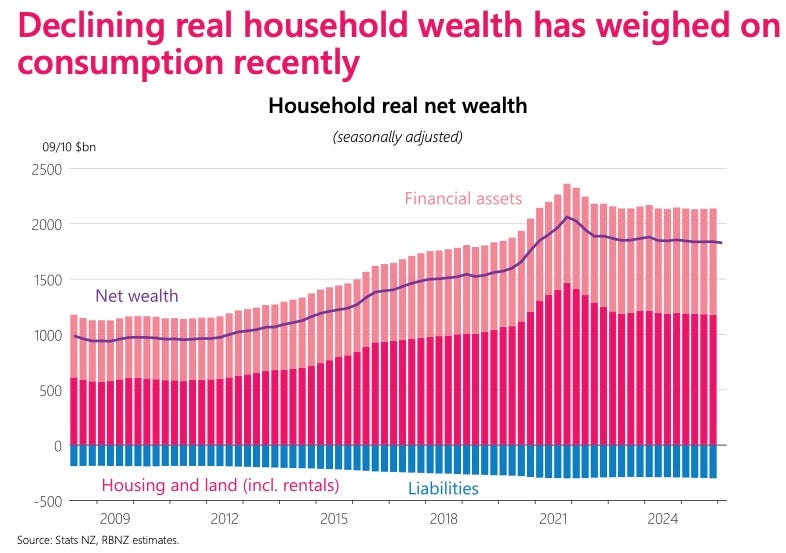
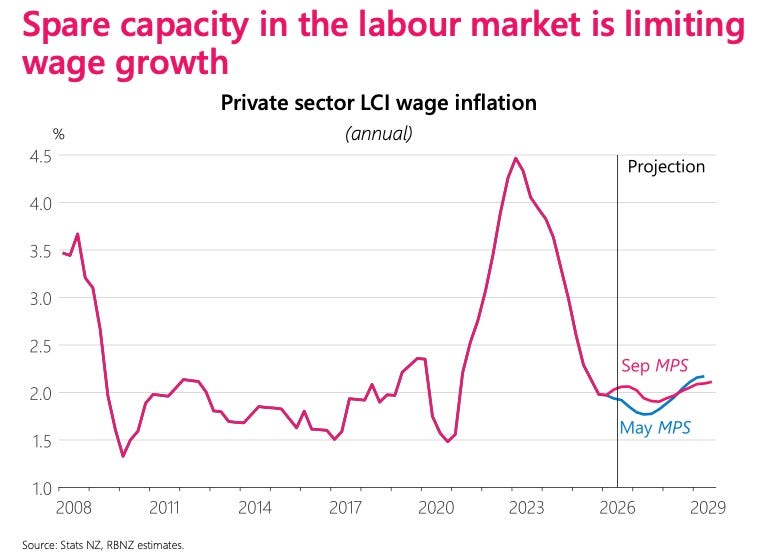
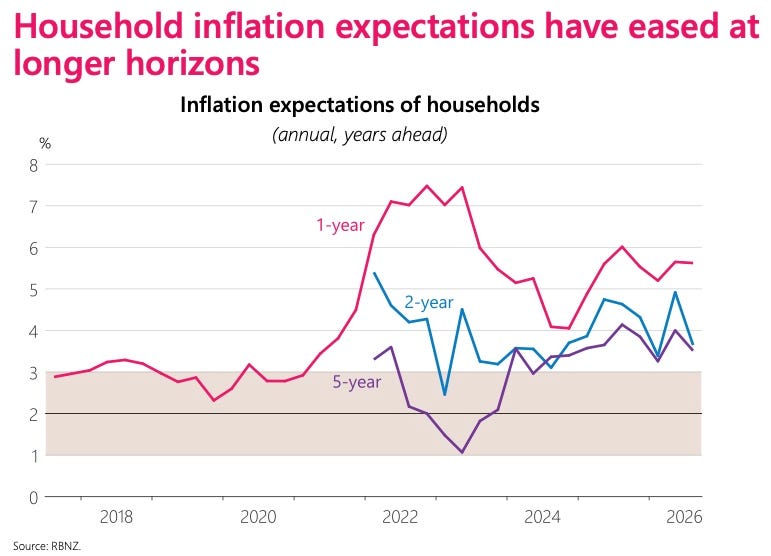
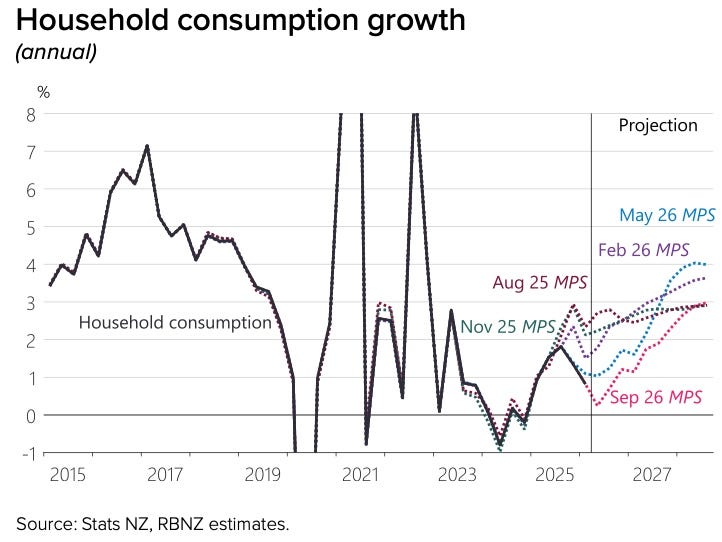
As the Reserve Bank itself said yesterday, and its charts below show, there is no domestic inflation problem and consumer and investment demand is flat on its back. The Reserve Bank forecasts a rebound in consumer spending and employment, based on the its view that interest rate levels are currently stimulative and that higher real house prices (from later next year) will boost consumer spending. But its own chart on page 38 (see below) shows its rebound forecasts has been consistently wrong for years.
The ultimate painful irony is that this second rate hike, with two more projected to come in the next six months or so, will actually increase capital cost inflation that has worked its way into Consumer Price Index inflation in recent years through the increasing use of capital-user-pays charges by councils and the Government, along with regulated price increases in electricity and gas that are linked to capital cost.
Ka kite anō
Bernard
PS: I’ve included fewer links elsewhere today to give space for the RBNZ decision.