
After a decade of rapid expansion, private credit is entering what may be its first meaningful stress test. The asset class has grown into a multi-trillion-dollar market, attracting both institutional and wealth capital, supported by its promise of stable income and downside protection. However, in recent months we have seen a shift in sentiment, as rising redemption requests, discounts in listed vehicles, and broader market volatility have triggered renewed scrutiny around the resilience of the model.
At the center of the debate is a familiar question: whether private credit represents a structurally sound evolution of lending markets, or whether it carries hidden risks that could emerge under pressure. Blackstone’s recent “Myth vs. Fact” analysis pushes firmly toward the former, arguing that many of the current concerns reflect misunderstanding rather than deterioration in fundamentals.
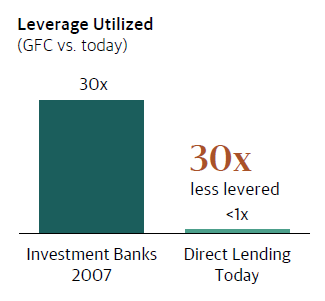
Leverage in today’s private credit vehicles remains significantly below pre-Global Financial Crisis levels, typically under 1x compared to 25–40x in banks prior to 2008. At the same time, lending standards appear more conservative, with loans generally structured as senior secured and underwritten at approximately 40% loan-to-value, supported by substantial equity cushions.
Deal leverage today vs. pre-GFC¹

This structural positioning is central to the argument that private credit does not pose systemic risk in the same way as past credit cycles.
Historical performance provides further support for this view. Over the past two decades, private credit has demonstrated limited loss experience, with realized losses of approximately 1%, even across periods of market volatility. At the same time, underlying borrower fundamentals remain relatively stable, with portfolio companies continuing to generate earnings growth, around 10% on average, and improving interest coverage ratios.
Private credit resilience during market stress²

However, the current environment still poses challenges. The rapid growth of the asset class, combined with increased participation from semi-liquid vehicles, has introduced new dynamics, particularly around liquidity management. Redemption limits, which have recently come into focus, are often perceived as a constraint, yet are in fact a defining feature of the structure. By limiting forced asset sales, these mechanisms aim to protect portfolio integrity and investor outcomes over the long term.
At the same time, sector-specific risks, particularly in software, where artificial intelligence may disrupt business models, are increasingly part of the conversation. While acknowledging these risks, current loan structures provide meaningful protection. This is largely because lenders typically finance only a portion of a company’s value. With loan-to-value ratios around 37%, there is a substantial equity buffer, meaning company valuations would need to fall significantly before lenders begin to incur losses.
Taken together, these dynamics suggest that the current environment reflects less a structural breakdown and more a transition in market conditions. The “golden era” of private credit, characterized by elevated yields, abundant deal flow and limited competition, has likely given way to a more normalized phase, where returns are increasingly driven by underwriting discipline, sector selection and manager quality.
As scrutiny intensifies, dispersion across strategies and platforms is likely to widen. For investors, this implies a shift away from broad exposure toward more selective allocation, with greater emphasis on credit quality, structuring and alignment of liquidity terms. While the asset class may continue to offer attractive income and diversification benefits, its performance in the coming years will depend less on structural tailwinds and more on execution.
In this context, private credit is not facing a systemic crisis, but it is, perhaps for the first time, being tested under more demanding conditions.
Article prepared by Qualitas Funds
You can read Blackstone’s full report here