

Korea adopts AI faster than productivity grows
AI gains remain concentrated in higher-paid work
Implementation determines whether efficiency becomes output

AI now saves the global economy about $2.7 trillion a year in labor time, which is equivalent to 3.4 percent of GDP in the eighty-six countries covered by the most recent relevant research. This size has more than doubled in six months and at first glance it looks like proof that AI has already spread everywhere at once. But if we take a closer look at where the value really ends up, the picture changes. In poor countries, almost every dollar of measurable value from AI flows to a narrow band of professionals at the top of the salary scale. In rich countries, the same value extends to a much wider segment of the workforce. Korea complicates this clear narrative. It is an affluent economy, with a dense digital infrastructure and high wages. However, the use of AI there does not behave as well as in countries with a corresponding income. It looks more like an economy that is still waiting for technology to pay off.
The AI Concentration Gap in a High-Wage Economy
Recent research, based on five waves of usage data from dozens of countries, introduced an indicator known as the AI concentration index, which captures whether the value created by AI flows primarily towards already well-paid occupations or spreads more evenly across the workforce. A price close to one means that almost all of the value goes to the highest paid earners. A value close to zero means that benefits are widely shared across all salary brackets. The pattern by income group is stark. In sub-Saharan Africa and South Asia, where the per capita income is below five thousand dollars, the index is between 0.9 and 1.0, i.e. almost all the measurable benefit ends up in a slim professional elite. In Western Europe and North America, where per capita income exceeds fifty thousand dollars, the same index mainly ranges between 0.4 and 0.6, dropping as low as 0.17 in Norway.
This scale is not just about where AI is concentrated within a country. It is also about how much value a country derives in relation to the size of its economy. High-income countries reap AI benefits of around 4.2 percent of GDP, middle-income countries around 0.6 percent and low-income countries just 0.1 percent. High-income countries account for 96 percent of the total measurable global benefit, while employing a much smaller proportion of the global workforce. Korea belongs to the high-income category in all these criteria. It has one of the highest adoption rates of generative AI globally, a robust digital infrastructure and salary levels that would predict the same widespread diffusion seen in Australia, the United Kingdom, or the wider European economies. What is observed on the contrary is different. The intensive use of AI has not yet produced the visible, evenly distributed benefit that the country’s income and infrastructure would provide.
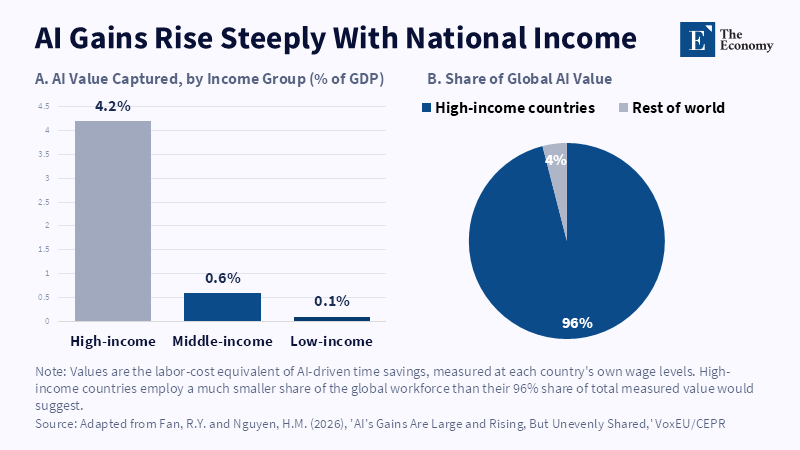
The researchers behind this indicator carefully point out its limitations and these limitations matter for a proper reading of the case of Korea. The underlying quantity measures the time saved at each country’s wage levels rather than on the production made and is derived from the use of a single AI provider rather than the entire market. Both of these options lead to the concentration gap being treated as indicative rather than accurate. Nevertheless, the direction of the finding is confirmed in every check reported by the researchers. A high-wage economy whose measured concentration behaves like a slower-growing economy is a real anomaly, not a rounding of error. This does not prove that Korea has failed to benefit from AI. But it shows that wages and infrastructure alone are weak predictors of how evenly a country is turning the use of AI into broad economic value.
Two Barometers Behind the Global Pattern
The researchers in this study identify two distinct forces that explain the differentiation between countries, both answering different questions. The first explains how much value a country derives in relation to the size of its economy. Institutional preparedness, i.e. how prepared a country’s rules and institutions are to support AI development, is the strongest predictor here, along with the size of the country’s service sector. Economies that combine clear regulatory frameworks with a large service base derive the most measurable value from the current use of AI.
The second barometer explains something different: whether this value spreads more evenly over time or remains locked at the top. This is where language and the composition of AI training data play the most important role. Countries where English is an official language and whose institutions and public knowledge are well represented in the texts used to train the large language models, are seeing their concentration index fall faster as adoption expands. Countries with an unusually large service sector, by contrast, tend to see concentration rise rather than fall because AI use there is even more concentrated in knowledge-intensive roles. Korea, where English is not an official language, sits at an uncomfortable crossroads. Its institutional readiness supports AI adoption, while linguistic distance and the structure of its highly digitized service economy may work against a broad and rapid diffusion of those gains.
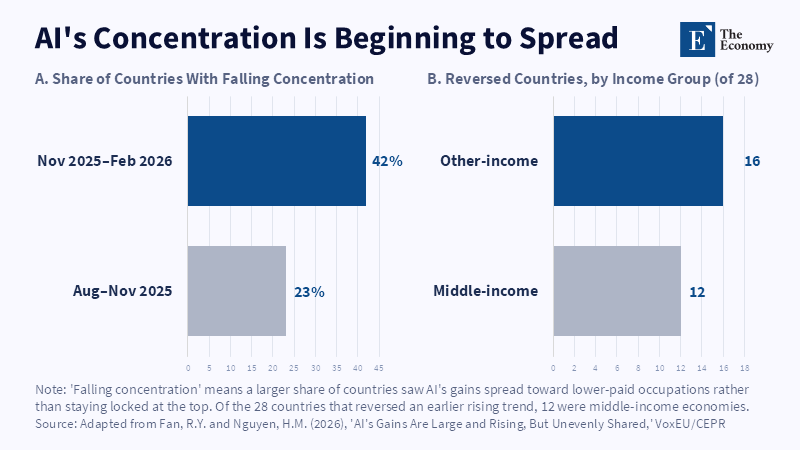
Institutional readiness is not an abstract score. It covers whether a country has clear rules on data use, responsibility and cross-border deployment, clear enough for businesses to build products and internal systems around AI without waiting for the legal landscape to become clear. Economies that reach this clarity earlier tend to see AI move faster from pilots to day-to-day operations across a broader set of businesses, which over time diffuses value beyond a small professional core. Where this clarity is delayed, AI tends to concentrate on the few businesses and roles that can absorb legal and organizational uncertainty on their own. This pattern is very similar to the one described by Korea’s own data.
Non-Performing Adoption: What Korean Workers Report
A representative survey of more than five thousand Korean workers, conducted by Bank of Korea economists in mid-2025, offers a detailed picture of what is really happening at the level of individual jobs. It found that 51.8 percent of workers already use generative AI for work activities, a percentage that the researchers describe as about double that of the United States in the same period. Among active users, AI reduced working time by an average of 3.8 percent. These figures alone would indicate that Korea is ahead, not behind, of the economies of equivalent income in converting AI into measurable benefits.
The same research found something that is difficult to reconcile with this narrative. The correlation between the time saved by each employee using AI and the change in their declared output was almost zero, at 0.008. The time saved did not translate into more production. In contrast, the research found that most of the time saved resulted in a 1.3 percentage point increase in breaks within working hours, meaning employees completed the same amount of work with less active effort rather than producing more with the time freed. Production quotas that remain fixed no matter how efficiently a task is completed give workers every reason to keep the saved time as a break instead of turning it into extra work. This single behavioral choice, repeated in much of the workforce, is enough to explain why a country with unusually high adoption can still record weak, unevenly distributed measurable benefits at an overall level.
The detail at the level of work sharpens the argument even more. Time savings were highest in professional and administrative jobs, around 2.8 percent and 1.9 percent respectively and lower in manual, service and basic occupations, reflecting the same bias towards already well-paid roles seen internationally. Within each employee’s to-do list, a single main task accounted for an average of about seventy percent of the total time savings. In other words, AI acts as a targeted tool for specific points and not as a broad accelerator across the entire workplace. This narrowness matters in the narrative of the gathering. When savings are so tightly concentrated around one job per employee, the argument in favor of reorganizing an entire role around technology is weakened. This helps explain why such an AI-savvy workforce has yet to produce the broad, measurable benefits that their income level would predict.
From Access to Implementation
A separate research stream, based on real-time AI usage data captured through an API routing service rather than survey responses, offers a structural explanation for why adoption and performance can diverge so sharply. Businesses whose AI consumption came from leading, closed-source models, paid and longer-term accounts and large, technically demanding prompts were associated with significantly higher stock market returns than businesses whose use appeared occasional or experimental. The value-weighted difference was about 64 basis points per week. Businesses that used AI on the surface, with minimal effort, had almost no effect on this size.
Access alone appears to carry a much weaker market signal. AI tools are now relatively cheap and widely available. It assesses implementation: whether a business has actually reconfigured workflows, delegated responsibilities and trained staff around the technology, rather than just issuing licenses. Official statistics show the same gap. Broad indicators of AI use in enterprises in Europe and the United States move well above indicators of AI truly integrated into production, sometimes by a factor of two or three. Based on this context, Korea’s high adoption rate looks closer to the access side than the app side. The widespread use of the tools has not yet been accompanied by the organisational restructuring needed to convert the time saved into higher production instead of stockpiled rest.
The size of the business adds one more layer to the same pattern. Among businesses in the European Union in 2025, just over 55 percent of large businesses reported using at least one AI technology. Only about 30 percent of medium-sized enterprises and 17 percent of small ones did the same. The researchers link this gap to the fixed costs of building organizational capacity, not to a real difference in access. A model can be licensed by any business within an afternoon. The systems, staff training and internal trust needed to pass real decisions through it take much longer to build and only larger, better-organized businesses tend to absorb those costs quickly. Korea’s business base, as in most developed economies, still has a long queue of small and medium-sized businesses going through the same fixed costs. High national adoption combined with a slowly changing concentration index is exactly what this pattern would predict.
Salary data, research findings and market-based implementation index lead to the same conclusion from three different perspectives. A country may rank near the top of the world in wages, infrastructure and adoption and still lose the broad, visible benefit from AI that would predict its income level. Concentration and performance depend on how AI is integrated into the work, not just how often it is opened. The global size of $2.7 trillion captures the scale. It says much less about which economies have actually turned access into an advantage. Korea is the clearest reminder to date that these two things are not the same. Closing the AI concentration gap will require less emphasis on adoption headlines. It will require more work on the harder, slower task of restructuring production targets and responsibilities, now that the tool is already in everyone’s hands.
This article reflects the analytical judgment of The Economy Editorial Board and does not constitute policy advice or the official position of any affiliated institution.
References
Anthropic (2025) Estimating AI Productivity Gains from Claude Conversations. Anthropic Research, 25 November.
Fan, R.Y. and Nguyen, H.M. (2026a) Aggregate Gains from AI and Their Distribution: Global Evidence from Usage Data. IMF Working Paper No. 2026/147. Washington, DC: International Monetary Fund.
Fan, R.Y. and Nguyen, H.M. (2026b) ‘AI’s gains are large and rising, but unevenly shared’, VoxEU, Centre for Economic Policy Research, 20 August.
Lee, K. (2026a) From AI Access to Organizational Capability: Pricing the Corporate AI Transition. Swiss Institute of Artificial Intelligence, 9 August.
Lee, K. (2026b) The AI Premium Is About Implementation, Not Access. Swiss Institute of Artificial Intelligence, 11 August.
Suh, D. and Oh, S. (2026) Generative AI and the Reallocation of Time: Productivity, Leisure, and Fulfilling Work. Working Paper, Bank of Korea, 12 February.