
Watching his four-year-old son search for insects along the Liangshui River, Liang, 36, found himself reflecting on how they would each remember the same neighborhood in a different light.
The Dahongmen of his childhood was home to one of China’s busiest clothing wholesale markets, where trucks clogged the streets, merchants shouted across endless rows of stalls, and countless fortunes have been made. His son, however, knows a different Dahongmen — one with riverside paths, museums and technology companies housed in former market buildings.
The contrast captures a transformation that reaches far beyond a single Beijing neighborhood. As China’s urbanization shifts from rapid expansion to a focus on quality, cities are embracing urban renewal to spark new growth within their existing landscapes.
WHEN THE MARKET FELL QUIET
Dahongmen, literally meaning “Big Red Gate,” was named after a gate leading to an imperial hunting ground along Beijing’s South-Central Axis.
Centuries later, as reform and opening up gathered pace in the 1980s, migrants from Zhejiang Province, many of them tailors from Wenzhou, transformed the area into a major distribution hub connecting coastal factories with retailers across northern China.
At its peak, the district was home to more than 7,000 merchants and attracted around 100,000 buyers during peak seasons.
“You couldn’t drive through here in less than an hour,” Liang recalled. “Traffic barely moved.”
But the business model that fueled Dahongmen’s prosperity gradually lost momentum. As e-commerce reshaped apparel distribution, the district’s outdated wholesale economy exposed the costs of rapid expansion, including congestion, unauthorized construction and deteriorating public spaces.
In 2014, Dahongmen began relocating its wholesale markets as part of Beijing’s broader effort to relocate the functions that are non-essential to its role as China’s capital to neighboring Hebei Province and Tianjin. By the end of 2021, the last four major clothing wholesale markets in Dahongmen had closed, bringing nearly three decades of wholesale trading to an end.
Much of the original structure of the buildings has been preserved, but little remains inside the wholesale markets that once occupied them. Rows of cramped stalls have given way to bright offices and open work spaces, where technology companies now share light-filled atria.
The changes go beyond the buildings themselves. Walking paths, green spaces and public facilities now occupy areas once dominated by trucks and wholesale traders. Plans for a cluster of museums, which include a branch of the Natural History Museum of China, promise to introduce vibrant new cultural attractions to the neighborhood.
Official data show that, compared with the district’s peak years, congestion in the former wholesale district fell by 81 percent, while average traffic speeds increased by 50 percent.
For nearby residents, the benefits are perhaps felt most clearly in everyday life.
“The feedback I hear most often can be summed up in one sentence,” said a longtime resident. “Life here is getting better every day.”
BUILT FOR THE LONG RUN
Following the closure of the wholesale markets, local authorities began looking beyond short-term returns and investing in industries that take longer to develop but promise more sustainable growth.
“In the past, this area thrived on the intensive flow of people and goods,” said Zhang Xiaodong, director of the administrative committee for the South-Central Axis area. “Today, we are banking on technology, businesses and talent to drive future growth.”
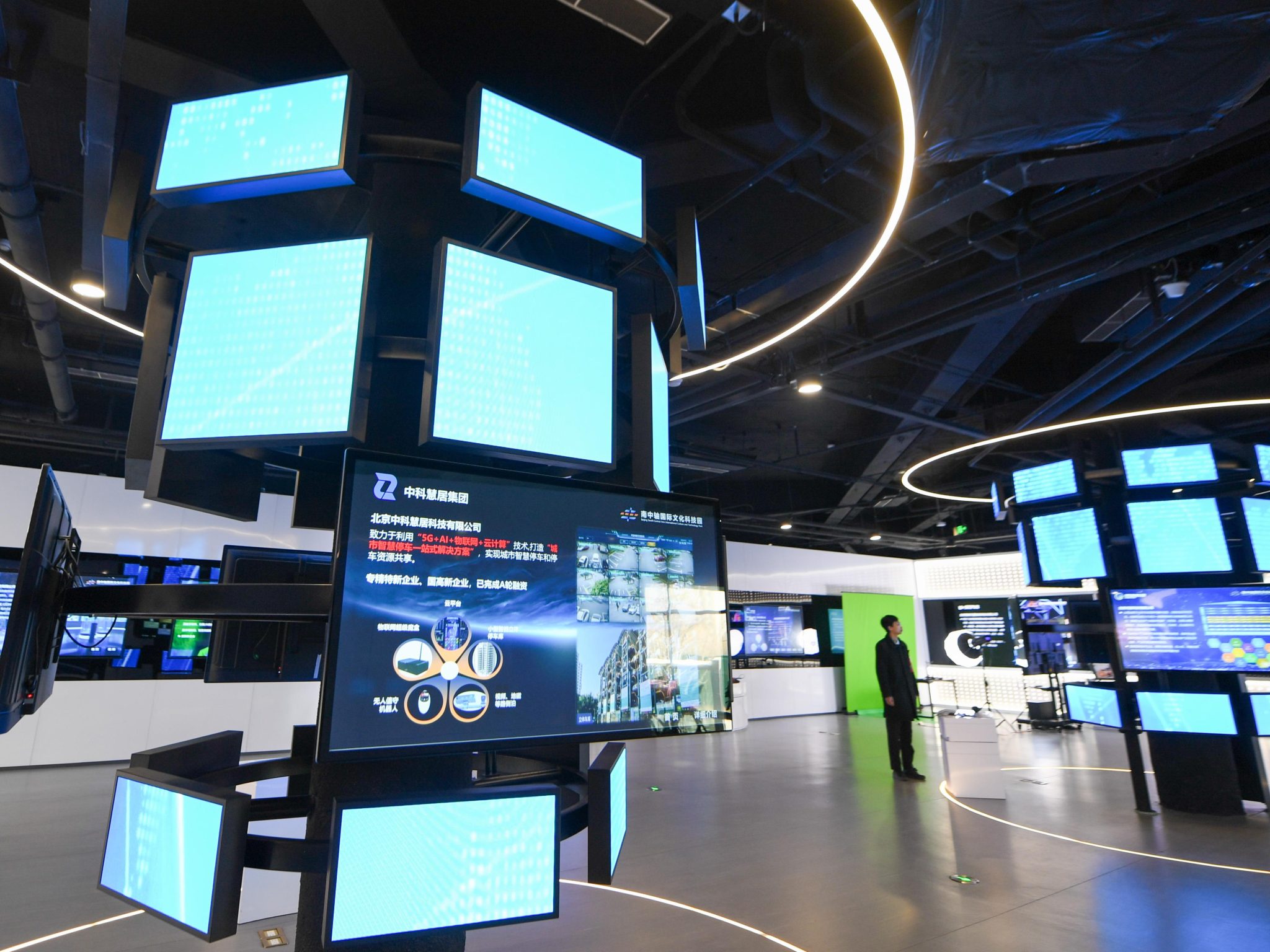
That approach is exemplified by the Beijing South-Central Axis International Culture and Technology Park. Opened in 2021, the project converted former wholesale market buildings into a hub for artificial intelligence, digital content and other emerging industries.
Its role isn’t just limited to providing office space. Working with local authorities, the park’s operators help startups navigate everything from company registration and financing to business matchmaking and technology partnerships.
“Urban renewal cannot stop at renovating a building and finding tenants,” said Li Jingyi, a staff member at the park. “The real work lies in operating it for the long term.”
That long-term approach attracted Beijing Hanjie Technology, one of the park’s earliest tenants. Founder Zhao Yang said the district’s clear industrial positioning was a key reason for choosing the location. His company develops smart glasses for metaverse and cultural tourism applications.
“The park’s focus aligns closely with what we do,” Zhao said. “It is building an ecosystem around technology and cultural innovation, which fits our business well.”
The transformation has also reshaped perceptions of Dahongmen, he added. “People used to associate Dahongmen with a crowded wholesale market. Now they see a modern technology park. The change is remarkable.”
The same philosophy is evident in the nearby South-Central Axis Digital Intelligence Industry Building. By the end of June, 574 companies had registered or relocated their legal addresses there, with technology firms accounting for about 70 percent of the total.
“The project should not be judged by its financial return alone,” said Ban Jianwei, general manager of the building’s operator. “We also have to consider its broader social value.”
A NEW STAGE FOR URBAN GROWTH
The transformation of Dahongmen reflects changes in Beijing’s development priorities, Guan Mingbo, Party secretary and chairman of the South-Central Axis Group, said in a written response to Xinhua.
“The focus is no longer simply on expanding the economy, but on fostering innovation and digital economy-driven growth while optimizing the capital’s functions,” he said.
What is happening in Dahongmen is also taking place in cities across China. After decades of urban expansion, the focus is shifting toward improving the quality, efficiency and competitiveness of existing urban areas.
Former industrial sites are becoming cultural districts. Aging factories are being converted into innovation parks. Older commercial neighborhoods are finding new roles by combining emerging industries, public services and better living environments.
The trend is now reinforced by a blueprint recently released by the State Council. A new five-year plan for urban renewal identifies fostering new drivers of urban development as a top priority, calling on cities to strengthen innovation ecosystems, cultivate distinctive industries, and further unlock the potential of existing urban spaces.
For Liang, however, the transformation is measured less by policy than by everyday life.
“I still miss the old Dahongmen sometimes,” he said. “But I also like what it has become. It’s quieter, greener, and offers more possibilities for the next generation.”