

The Muhammadu Buhari administration did create a Presidential Economic Advisory Council which was funded through the Office of the Accountant General between 2021 and 2022. FIJ can confirm that the council received at least N1.18 billion for its activities between May 2021 and 2022.
The existence and legitimacy of this council has been called into question after Femi Gbajabiamila, the Chief of Staff to the President, disowned Prince Adeniyi Adeyemi Matthew, who has been presenting himself as Director General of the Presidential Economic Advisory Council (PEAC) and the Presidential Foreign Intervention Promotion Council (PFIPC).
The Presidency had said no such councils existed under President Bola Tinubu’s administration. Bayo Onanuga, a presidential spokesperson, had also said Adeyemi is standing trial for forging appointment letters and impersonating a public official.
Adeyemi has however insisted that official government records — including budget documents and administrative records — show that the councils exist. He has also accused Gbajabiamila of taking a bribe by proxy and asking for a percentage of the take-off grant for the agency.
FIJ can confirm that before the controversy surrounding the PEAC, Nigeria did have a council which had the same name and functioned with it.
FIJ reviewed government payment records from BudgIT’s Govspend portal, which mirrors the Open Treasury Portal, and found that the State House released N1,177,690,430 for the operations of the Presidential Economic Advisory Council between 2021 and 2022.
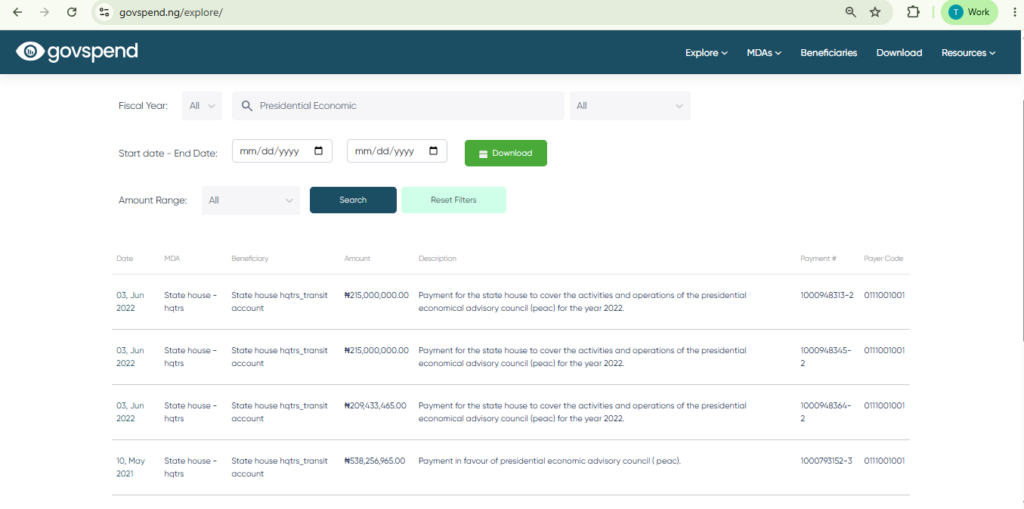
The payments include N538,256,965 made on May 10, 2021, described simply as a payment “in favour of the Presidential Economic Advisory Council (PEAC)”.
On June 3, 2022, the State House made three more payments — N215 million, N215 million and N209,433,465 — each described as payment “to cover the activities and operations of the Presidential Economic Advisory Council (PEAC) for the year 2022”.
Together, the four payments amount to N1.177 billion.
WHY BUHARI CREATED PEAC
The Presidential Economic Advisory Council was not created without a cause.
On September 16, 2019, barely four months after beginning his second term, Buhari dissolved the Economic Management Team (EMT). The body was chaired by then Vice President Yemi Osinbajo and it had coordinated the country’s economic policies.
In its place, Buhari announced the creation of the Presidential Economic Advisory Council. He said the new body would report directly to him rather than through the Vice President.
The Presidency said the council’s responsibility would be to advise the President on economic policy, analyse domestic and global economic developments, and recommend strategies for sustainable growth.
Unlike the EMT, which consisted mainly of serving ministers and heads of government agencies, PEAC was designed as a council of independent economists.
Buhari appointed economist Doyin Salami as chairman. Other members included former Central Bank Monetary Policy Committee member Mohammed Sagagi, former CBN governor and economist Chukwuma Soludo, financial analyst Bismarck Rewane, economist Iyabo Masha, public finance expert Ode Ojowu and development economist Shehu Yahaya.
The Presidency said the council would hold technical meetings every month and meet with Buhari every quarter to present recommendations on Nigeria’s economy. For nearly three years, PEAC served as Buhari’s principal external economic advisory body.
In January 2022, Buhari further strengthened the arrangement by appointing Salami as Chief Economic Adviser to the President while he remained chairman of PEAC.
The move effectively linked the Office of the Chief Economic Adviser with the advisory council and placed Salami at the centre of the administration’s economic policy circle.
It was during this period that the council received the N1.18 billion FIJ identified in government payment records.
WHAT CHANGED UNDER TINUBU
When Tinubu assumed office in May 2023, he did not retain Buhari’s Presidential Economic Advisory Council.
Instead of appointing a new Chief Economic Adviser after Salami left office, Tinubu named economist Tope Fasua as Special Adviser on Economic Affairs.
Months later, in March 2024, he established the Presidential Economic Coordination Council (PECC), a body bringing together ministers, the Central Bank governor, state governors and private-sector leaders to coordinate economic reforms.
The new structure effectively replaced Buhari’s PEAC.
But even after abandoning Buhari’s advisory architecture, Tinubu’s administration proposed N215.8 million in the 2024 budget for the Office of the Chief Economic Adviser despite not appointing anyone to occupy the position.