
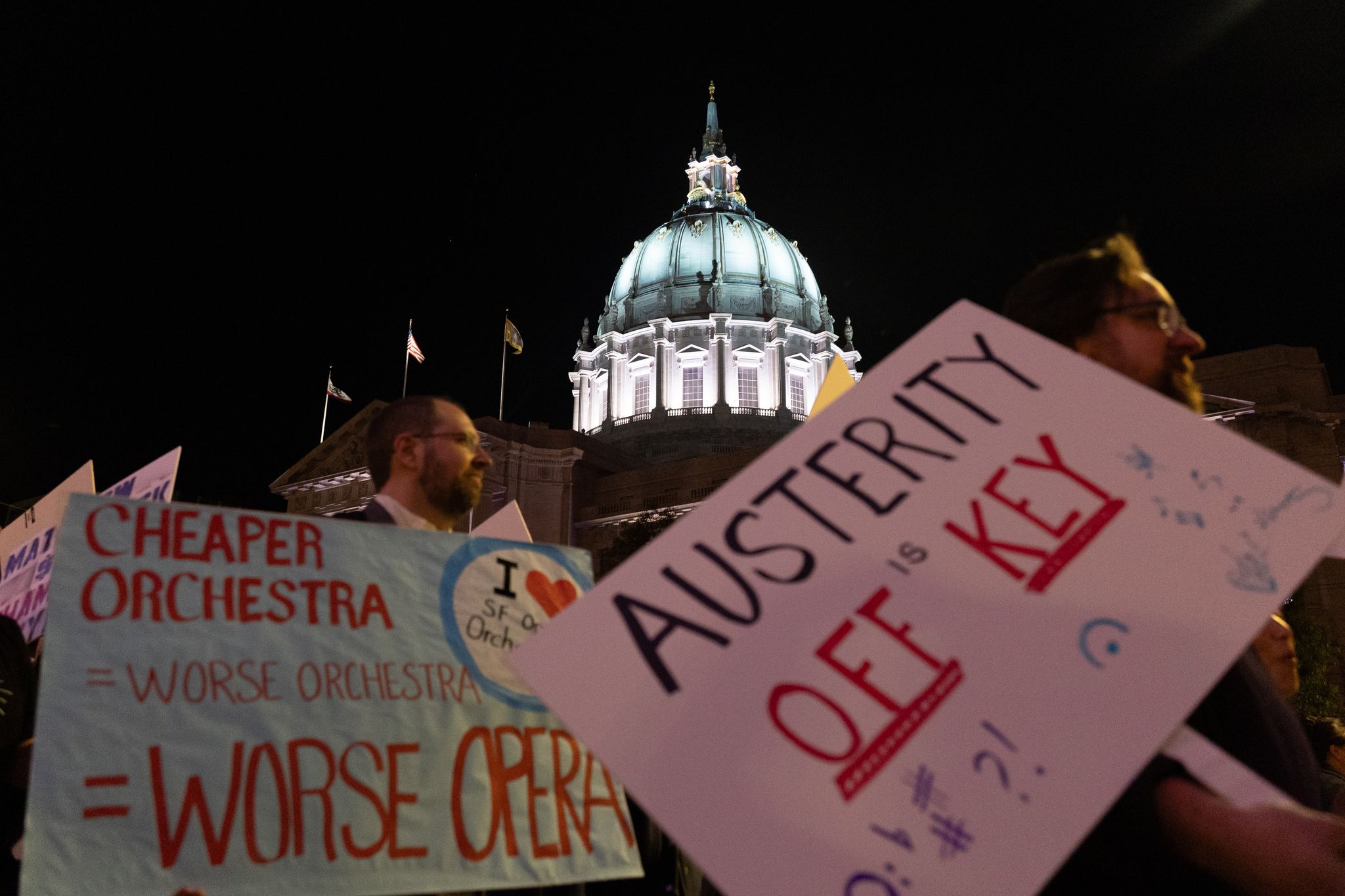

Striking San Francisco Opera musicians march outside the War Memorial Opera House on Saturday. The Opera suspended its season and cancelled performances through Sunday.
The San Francisco Opera began its 104th season with an empty orchestra pit. The musicians went on strike shortly before the Saturday premiere of Verdi’s “Simon Boccanegra,” leading to the cancellation of the season opener. Since then, the company had suspended the season, canceling performances through Sunday as the musicians and management tried to reach an agreement on wages, guaranteed working hours and the institution’s financial future.
San Francisco Opera management and its orchestra musicians reached a tentative agreement late Thursday on a new contract that must be ratified before performances are held.
I am no expert in labor economics, and history cannot dictate what a fair contract for San Francisco’s musicians should look like. But as a music historian whose research focuses on 19th century musical institutions and patronage, I recognize the broader issue underlying this dispute.
Article continues below this ad
Staging an opera has always been an extremely costly endeavor, and the ticket buyer has rarely been the only one footing the bill. Data from the San Francisco Opera itself vividly illustrates a modern version of this problem. The company stated that it has an annual structural deficit of approximately $15 million. According to its most recent audited financial statements, ticket sales revenue totaled $13.8 million, while operating expenses reached $82.6 million. Consequently, a significant portion of the organization’s funding must come from sources other than box office receipts.
To a modern audience, this may seem like proof that such a business model is unsustainable. However, from a historical perspective, the very assumption that ticket buyers should fully cover the costs of serious musical culture would itself have seemed strange.
In the world of 19th century music, which is my area of study, patronage was an integral part of cultural life. Opera houses sold tickets, but musical institutions also existed within networks of wealthy patrons and political authorities. In Eastern Europe, public concerts could coexist with aristocratic salons, accessible only by invitation, where wealthy hosts brought together audiences and musicians, and sometimes invited performers from abroad. Conditions varied significantly from place to place, but the basic principle is familiar to us from modern-day San Francisco: Someone other than the typical ticket-buyer had to help cover the costs of ambitious musical projects.
San Francisco serves as a striking example of this dynamic. When Gaetano Merola decided to establish a permanent San Francisco opera company in the 1920s, he secured the support of the city’s business community and patrons. Thus, patronage has been part of the institution’s history from its earliest years.
Article continues below this ad
The history of opera in San Francisco illustrates this point even more clearly. More than $2 million was raised from private sources for the construction of the War Memorial Opera House even before voters in the city approved the issuance of $4 million in municipal bonds. The building that now houses the Opera exists because a previous generation decided that having a major opera house was worth a collective investment.
This history makes me cautious about describing the Opera’s deficit simply as evidence of institutional failure. Opera is extremely costly because it relies on a concentration of highly skilled labor. There are limits to how much more efficient this work can be made before we begin to alter what we are supposedly trying to preserve.
Today, the Opera operates within the American nonprofit model, in which private donations cannot be viewed merely as an additional opportunity for philanthropy. This year’s postponement of the Opera Ball, one of the company’s major fundraising events, illustrates this interdependence particularly clearly.
The question of what patrons might offer in exchange for the musicians’ services also has a long history. The Irish pianist and composer John Field was invited to enter the service of an extraordinarily wealthy Russian aristocrat, Count Alexei Orlov-Chesmensky, but decided to decline. Patronage could provide musicians with significant opportunities, but the musicians could choose which arrangements they were willing to accept.
The current debate also highlights the limitations of historical comparisons. Management argues that the orchestra’s guaranteed workload no longer corresponds to the amount of work the company can consistently provide. The musicians, however, argue that reductions in the number of performances have contributed to the company’s difficulties and that the proposed changes will undermine their livelihoods. They are discussing the future of a living institution, not reenacting a 19th-century debate. Nevertheless, history changes the nature of the question we ask.
Article continues below this ad
When an opera company faces financial difficulties, it is tempting to conclude that audiences no longer value it highly enough. However, the San Francisco Opera reported an increase in subscription sales and successful fundraising even amid a significant structural deficit. This apparent contradiction becomes easier to understand if we abandon the notion that cultural significance and commercial self-sufficiency naturally go hand in hand. For most of the history of music, this has not been the case.
Guest opinions in Open Forum and Insight are produced by writers with expertise, personal experience or original insights on a subject of interest to our readers. Their views do not necessarily reflect the opinion of The Chronicle editorial board, which is committed to providing a diversity of ideas to our readership.
San Francisco should not view this strike as proof that opera has simply become an exorbitantly expensive luxury. The more complex question is whether a city as wealthy as San Francisco considers a permanent opera company to be part of the cultural infrastructure it wishes to preserve.
If the answer is yes, then someone must cover the difference between what it is reasonable to charge audiences and what it actually costs to stage an opera. This does not tell us whether management or the musicians should prevail in the negotiations, but it does mean that whatever agreement ultimately brings the musicians back to the orchestra pit will not solve the broader economic problem. A century ago, San Francisco responded to this problem by combining private philanthropy with public investment. The mechanisms have changed, but the fundamental dilemma remains the same. How much does the city value having an opera company, and who is willing to pay for it?
Stacy Olive Jarvis is a music historian, writer and classical musician whose research focuses on 19th century European musical culture, including musical institutions and patronage. Her work has appeared in the Philadelphia Inquirer, the Conversation and other publications.