
For decades, American foreign assistance has rested on the idea that humanitarian aid and development assistance can stabilize fragile countries, reduce poverty and create the conditions for long-term growth.
The Trump administration now wants to try something new.
“To be clear,” Ambassador Dan Negrea told me when we met in his New York office, “we’re not trying to replace aid.”
Negrea, who leads the team focused on humanitarian affairs at the U.S. Mission to the United Nations and helped shape the administration’s recently launched “Trade Over Aid” initiative, knows the phrase raises eyebrows in the development world.
Critics worry Trade Over Aid is a warning that America is abandoning the world’s most vulnerable in favor of commercial interests. Many assume the worst following the absorption of the U.S. Agency for International Development (USAID) into the Department of State, as well as sweeping reforms and sizeable cuts to American foreign assistance.
Administration officials push back, saying the initiative is designed to help countries transition to lasting economic prosperity by expanding opportunity rather than relying solely on long-term assistance.
The Administration’s Pitch
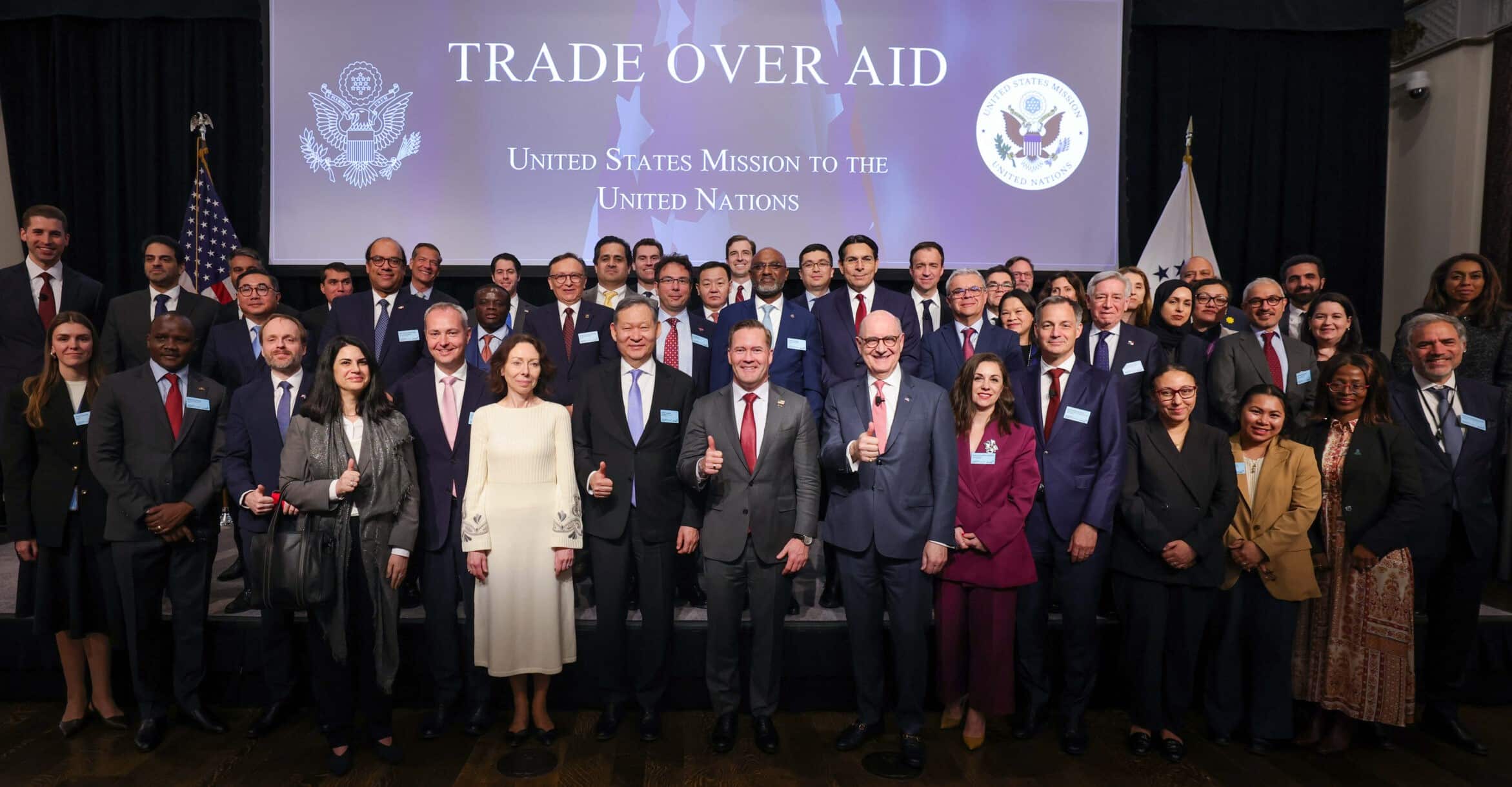
In April, U.S. Representative to the UN Ambassador Michael Waltz, and Negrea formally launched Trade Over Aid at the New York Stock Exchange alongside representatives from the World Bank, the UN Development Programme (UNDP), UNICEF and corporate partners including Google, Goldman Sachs and Microsoft. Thirty-six countries signed onto the nonbinding declaration backing the project. The launch was followed by a series of panels outlining the push to “empower countries by building capacity.”
The initiative’s founding declaration calls for “an international economic development vision built on free markets,” and emphasizes property rights, enforceable contracts and transparent governance. Containing five guiding principles, the plan positions assistance as a temporary catalyst for long-term economic growth.
Among the principles is also a clearly defined role for multilateral institutions. The declaration specifically calls on organizations like the UN to provide the “technical expertise and policy advice” necessary to build the “human and institutional capacity” needed for economic growth and stability.
In a nod to President Ronald Reagan, Negrea sums up the program more succinctly: “Just like the best welfare program is to give someone a job, the best types of development assistance are mutually beneficial business partnerships — in a word, trade.”
The Case for a Different Model
There’s a coherent intellectual case behind the administration’s approach.
At its core, Trade Over Aid taps into a long-running debate in development economics about how countries move from aid dependency to sustainable growth. The administration is hardly the first to argue that durable prosperity ultimately comes from functioning markets, local entrepreneurship and economic integration rather than perpetual donor support. Few policymakers or development advocates seriously dispute that private investment is essential to economic self-sufficiency, or that aid is meant to serve as a bridge rather than a permanent condition. Look no further than Asia’s Tiger economies like Singapore and South Korea for evidence of how rapidly trade and industrialization can transform societies.
What makes this moment different, officials say, is the growing sense that the traditional development model is no longer financially sustainable. Negrea points to shrinking long-term commitments from wealthy countries, rising debt, donor fatigue and growing concerns about inefficiency. In that sense, the U.S. frames the initiative less as a rupture than as a necessary adaptation to global realities in a system under pressure.
And in theory, at least, this isn’t intended to be a purely laissez-faire doctrine to simply unleash capital.
Negrea’s intellectual worldview — shaped by his upbringing in Communist Romania, from which he defected to the U.S. — offers important insight into how the initiative may ultimately take shape.
Before entering government, he led the Freedom and Prosperity Center at the Atlantic Council, where he argued that lasting prosperity depends not only on markets, but what he calls “enabling conditions”: functioning courts, enforceable contracts, transparent governance and trusted legal systems that allow investment to take root.
Creating those conditions for growth — what many development experts would contend traditional assistance already does well — is a prerequisite for investment. UNDP, a partner in the initiative, understands the challenge. “Markets do not emerge by themselves; they are built through institutions, infrastructure and policies that give investors confidence and people opportunity,” said Alexander De Croo, UNDP Under-Secretary-General. Investment, he added, flows where there is “stability, transparency and rule of law.”
A Selective Relationship with the UN
The administration’s posture toward the UN is more nuanced than many critics acknowledge. Contrary to the caricature of a White House reflexively hostile to the institution, officials at the U.S. Mission describe their approach as “selective” and “results oriented.”
UNDP, for example, has been identified as a “kernel of excellence” because its work on rule of law and other capacity-building essential to helping countries establish the foundations needed to attract investment and support long-term growth. In fact, the UN agencies that participated in the initiative’s launch were described by U.S. officials as “crucial to Trade Over Aid.”
“Governments work with UNDP to strengthen the conditions that allow markets to function and investment to grow,” De Croo said, citing reforms tied to tax systems, regulatory frameworks, institutional capacity and rule of law. According to UNDP, the agency has helped align more than $920 billion in public and private finance for development since 2022, while directing 91 cents of every dollar invested to programs and services.
Where Markets Fall Short
For all the economic logic behind the initiative, the real tension lies elsewhere: in countries without functioning markets, where crises like famine, disease outbreaks and civil unrest must first be stabilized before meaningful private investment or commercial activity can take hold.
After all, humanitarian systems exist precisely because some crises fall outside traditional market incentives — a concern that feels especially relevant against the backdrop of a weakened aid architecture.
Negrea acknowledges humanitarian needs are not disappearing. He points to the administration’s continued support for emergency relief efforts, including $3.8 billion in recent humanitarian funding delivered through the UN Office for the Coordination of Humanitarian Affairs, as evidence that Washington is not stepping away from humanitarian engagement. The latest $1.8 billion tranche was announced on May 14.
Still, there is skepticism. Critics hear “Trade Over Aid” and worry the United States is replacing moral obligation with transactional economics.
At the same time, there is relatively little concrete policy — and even fewer measurable outcomes — to evaluate. The initiative has yet to release a formal budget, detailed roadmap or clear benchmarks for success. Much of the debate has therefore become less about the initiative itself and more a proxy battle over the future of American development policy: What should development assistance ultimately achieve?
Is it primarily about reducing human suffering? Expanding markets? Advancing American geopolitical influence?
The truth is American foreign assistance has always tried to do all those things at once — often quite successfully. Programs like the President’s Emergency Plan for AIDS Relief (PEPFAR) saved millions of lives while simultaneously stabilizing strategically important regions and broadcasting American leadership. Food aid reduces starvation while easing migration pressures and political instability.
American foreign assistance has never been purely altruistic, just as trade has never been purely economic.
The administration is not wrong that long-term prosperity ultimately requires investment and local economic growth. But critics are not wrong that humanitarian systems are not interchangeable with market mechanisms.
The Test Ahead
Whether Trade Over Aid succeeds will depend on execution: Will humanitarian protections remain intact during the transition? Can investment reach fragile states, rather than bypassing them for safer markets? And how will the administration convince the world its intent is truly reform rather than retreat?
Negrea concluded our conversation not with ideology, but with what struck me as a genuinely honorable appeal.
“We’re trying to do something really good here,” he said. “We should see where it works and where it doesn’t, and then go from there.”
Perhaps there is more shared ambition in that statement than the debate often allows. The challenge is ensuring that, in building that future, the world doesn’t neglect those who still need help in the present.
If the administration can accomplish that — whatever the name of the initiative — will indeed be something really good.