
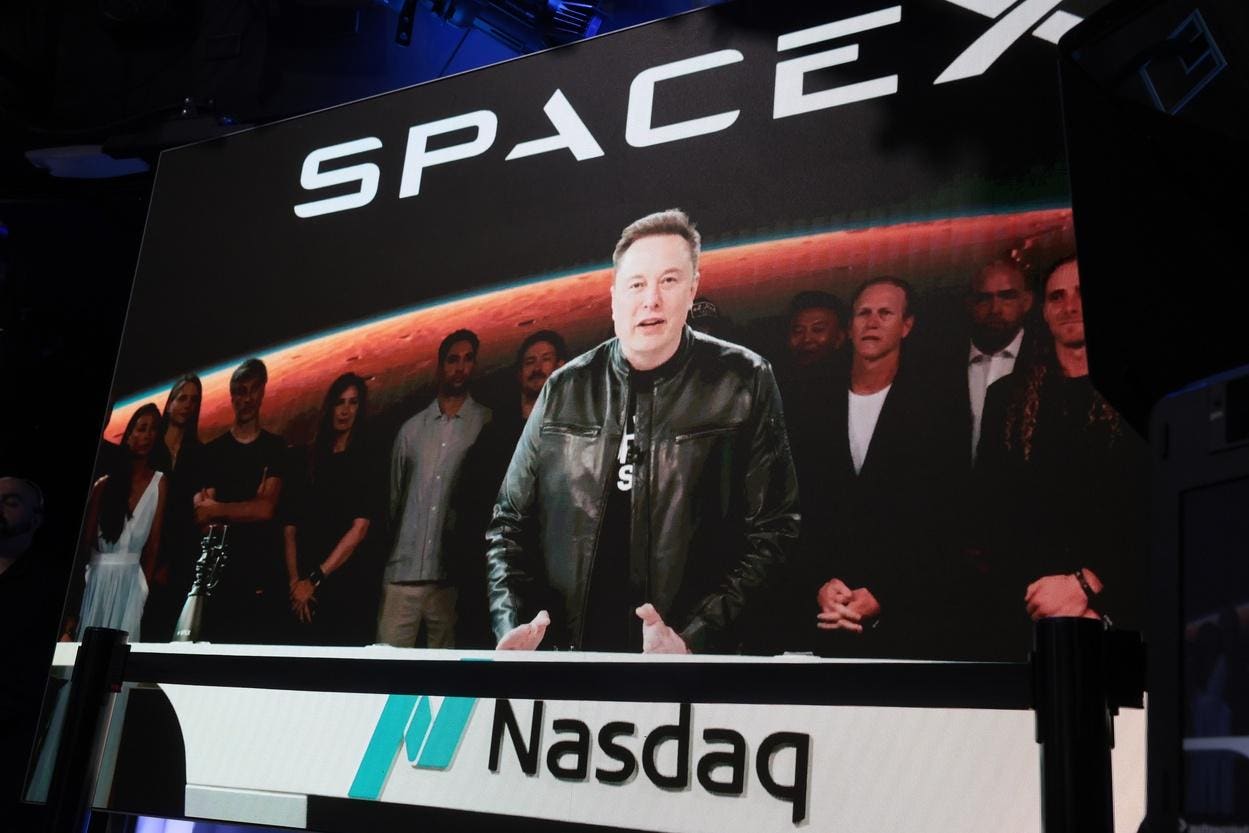

NEW YORK, NEW YORK – JUNE 12: Elon Musk, founder and CEO of SpaceX, speaks via video before the ringing of opening bell at the Nasdaq Marketsite at the launch of the company’s initial public offering (IPO) on June 12, 2026 in New York City. SpaceX is set to begin trading under the ticker SPCX following what is expected to be the largest initial public offering in history. Elon Musk, who also serves as chief executive of Tesla, could become the world’s first trillionaire. In a filing with the Securities and Exchange Commission, the company said it plans to raise $75 billion by selling 555.6 million shares at $135 each. (Photo by Spencer Platt/Getty Images)
Getty Images
SpaceX stock has lost a quarter of its value since peaking on June 16 following the company’s initial public offering. Due to equity investors’ faith in CEO Elon Musk the company was valued at $1.8 trillion while its actual business – which burns billions in cash – strikes fear in the hearts of debt-holders, according to the New York Times.
The equity is built on a conglomerate of unrelated business lines. As I wrote in May, SpaceX consists of a satellite-internet cash cow forced to subsidize a money-losing AI lab with Musk holding 85% of the votes and aiming at a huge bonus tied to colonizing Mars. Meanwhile the company’s investment-grade (Baa1/BBB+/BBB) debt trades like junk.
Wall Street analysts have not reached a consensus on where the stock will go next. CFRA’s price target – citing the risk SpaceX will fail to achieve its goals for Starship revenue, AI data centers in space, and making money from its chatbot xAI and the former Twitter (X) – implies SpaceX shares will drop another 23%. Raymond James believes the company’s total addressable market is $30 trillion – $1.5 trillion more than does Musk – and envisions SpaceX shares soaring 433%.
Why SpaceX Stock Fell 25%
The root cause of SpaceX’s stock price decline was the gap between the high valuation of its shares at the IPO and the low profit potential of the company’s business units. In addition, a few post-IPO financial moves further spooked investors.
The IPO price was managed to achieve a first-day pop. Only about 5% of SpaceX shares were sold to the public and shares were valued at an exorbitant 94 times sales. Record retail demand – 30% of total which was three to six times the usual allocation – and buying by index funds helped propel the shares, according to the New York Times.
One valuation expert said SpaceX was embarrassingly overvalued. The $28.5 trillion total addressable market cited in the IPO prospectus prompted NYU Stern valuation professor Aswath Damodaran to say “the prospectus was written by Grok,” reported CNBC. The IPO valuation was 27% too high based on his discounted cash flow analysis and the TAM estimate was a “hallucination” he “would be embarrassed to even put out,” he added.
Given SpaceX’s money-burning business model, it is no surprise that S&P projects the company will generate negative free cash flow through 2029. That’s because SpaceX reported a 2025 net loss of $4.937 billion. It gets worse – in the first quarter of 2026, its net loss was $4.276 billion the company spent $7.7 billion on AI capital expenditures.
SpaceX’s equity allocation is a significant risk for retail investors. Elon Musk holds the vast majority of the voting shares. Also important – a whopping 44% of the shares could be dumped by insiders in September – which may pressure the stock price.
On top of that, two significant events took place after the IPO. These included:
The latter offering – which prompted traders to price the bonds at junk levels – has not gone over well. “The biggest, most sophisticated investors in the world see a harder road to success than Musk touts and demand to be compensated accordingly,” noted Bloomberg. “Traders told Bloomberg they couldn’t recall another deal where prices sank that quickly,” added the New York Times.
The Bull And Bear Cases For SpaceX
Despite all this, the bull case prevails on Wall Street. That’s because 27 analysts set an average 12-month price target of $245.96 – suggesting 61.6% upside.
The bull case is a torrent of words at odds with cash flow reality. SpaceX is a vertically integrated platform — dominant launch, the largest satellite-internet network, and a call option on AI infrastructure and Mars — with Starlink’s cash flywheel funding it all.
Raymond James analyst Brian Gesuale wrote “just as railroads, electric grids, and the Internet reshaped prior economic eras,” SpaceX is “building the foundational platform for the next generation of industrial capacity.”
The pessimists would avoid SpaceX shares. These include GMO’s Jeremy Grantham who called its offering possibly “the craziest IPO in human history” and said he’d only be interested “at 10 cents on the dollar.” Paul Krugman likened the company to a “Ponzi scheme.”
The one reasonable hope for SpaceX bulls is if the company reports consistently better than expected results — such as a clear and compelling path to profitability in its money-incinerating Launch and AI units.
Otherwise, those who bought into Musk’s reality distortion field may lose money on SpaceX stock.