
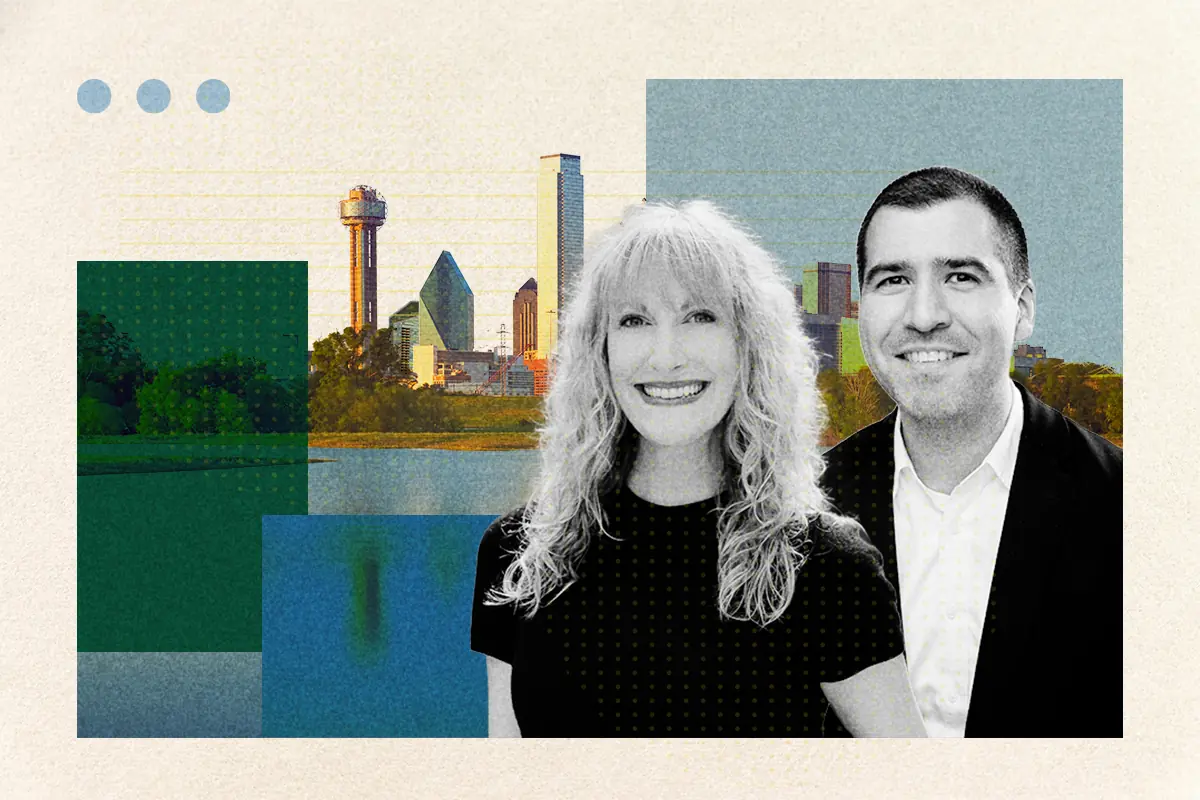
From a mixed-use development reshaping the Dallas Design District to a student hub serving one of Texas’ fastest-growing universities, Joseph O’Connor and Jessica Collins are helping define how people experience the city. As leaders in HOK’s Dallas studio, the pair have built a reputation for creating spaces that blend functionality, hospitality, and community impact.
O’Connor, a senior project designer, has led major projects including Hi Line Square and the University of Texas at Dallas Student Union. His work spans architecture, interiors, and master planning, bringing a multidisciplinary approach to developments designed to elevate urban life and create memorable experiences for users.
Collins, director of design for interiors, focuses on workplace environments that help organizations not only attract talent and strengthen culture but reflect their brand identity. Recognized for her collaborative approach and emphasis on human experience, she has helped shape HOK Dallas’ growing influence in the commercial real estate and design community.
O’Connor and Collins recently spoke with D CEO about their path into design, the projects shaping Dallas, and the trends influencing the future of architecture and interiors.
This conversation has been edited for clarity and brevity.
D CEO: Why did you decide to go into your line of work, and what do you enjoy most about it?
JESSICA COLLINS: “I chose interior design because it has the power to genuinely improve people’s lives. Beneath the surface of beautiful materials and finishes, this profession is fundamentally an act of service. Thoughtful design can heal, motivate, comfort, and restore simply by honoring human needs and creating spaces that are inclusive and intuitive. Color can influence heart rates. Light can shift a mood. A well-considered environment can bring dignity and calm to moments that feel anything but.
“What I enjoy most is the privilege of shaping spaces that quietly communicate belonging. Design gives us the ability to tell someone—without a single word—that they are welcome, they are safe and they are free to move through the world with confidence. That impact is what keeps me inspired every day.”
JOSEPH O’CONNOR: “Architecture is an interesting puzzle and I enjoy complex problem-solving that results in a spatial solution. I view design as a layering of both the logic of the project—real estate criteria, functional aspects, programming, client requirements—with the creative expression of the project. Ultimately these layers need to be a cohesive, refined solution and working through an inherently ambiguous process to arrive at this solution is always an interesting challenge.
“What I enjoy most is the collaborative creative process that happens when you get a room of interesting people of diverse disciplinary backgrounds to tackle spatial design problems. There is a quiet satisfaction in knowing that the result of this collaboration—within the team and with our clients—is a tangible space that people will inhabit, interact with, and genuinely enjoy being in every day.”
D CEO: What are you most proud of, in terms of projects and achievements over the last year?
O’CONNOR: “In 2025, my proudest achievement was the successful evolution of the HOK Dallas studio into a fully integrated, multi-disciplinary design collective. While the firm itself has a global footprint and larger headcounts in other major US cities, we saw the Dallas studio as an opportunity to cultivate a smaller, more integrated team given our smaller o8ice size. This scale allows us to bridge traditional silos between architecture, interiors, and landscape design, fostering a nimble environment where a single cohesive team touches every layer of a project. This is common in small design practices but harder to achieve in the context of a global firm.
“Additionally, this integrated approach gives us the freedom to take on unique projects and studies that blur standard project typologies. We’re able to solve complex spatial puzzles that larger, more rigid o8ice structures might struggle to address.”
COLLINS: “Joseph really said it best. I’m so proud of how our studio has grown and evolved over the last year to blur the lines between disciplines, and two incredible additions to our leadership have continued to bolster the momentum. I’m equally proud of the recognition our work received this year, with two projects earning industry awards. And on the home front, my two-year-old mastered potty training, which felt like its own gold medal moment.”
D CEO: What is the biggest lesson you’ve learned in your career?
COLLINS: “The biggest lesson I’ve learned is that the grass is greener where you choose to water it. Your career doesn’t just happen to you – you shape it. When something feels o8, speak up. When you need support, ask for it. And when your personal values align with your firm’s values, you never have to hesitate, because you know you’re surrounded by people who want you to thrive. “
O’CONNOR: “The most enduring lesson I’ve learned is that design is about building meaningful relationships. Architecture and real estate are inherently a long game, and the quality of the project is a direct reflection of the trust established between the designers, the client, and the broader community that interact with the project.
“I’ve learned that issues that arise in projects – ranging from objective issues like an evolving pro forma to more subjective issues such as di8erences of design opinion – are far easier to navigate when there is mutual respect for everyone’s contribution and role on the team.”
D CEO: What is the most interesting trend you’re watching in your industry?
O’CONNOR: “This is maybe less of a trend and more of a mindset that interests me that I feel will become more prevalent in the next few years. I’m curious to see the evolution of hybrid project typologies and what that means for design.
“While hospitality-driven design has dominated the industry across project types for the last decade, I think we’re moving past the novelty phase of putting a co8ee bar in a lobby or a speakeasy in an o8ice space. Making everything mimic the feel of a boutique hotel was an interesting idea but now that it’s so commonplace it’s become the baseline—i.e. when everything is boutique, nothing is boutique.
“I’m interested in how we take this to the next level by truly blurring functional lines, pushing design boundaries, and being intentional about hybridizing design. It goes beyond the aesthetic appearance of a project and is more about how a project works and feels.”
COLLINS: “One of the most compelling shifts right now is the move from designing static spaces to designing experiences that adapt in real time. We’re seeing workplaces, hospitality environments and even healthcare settings embrace data-informed flexibility, with spaces that respond to how people actually use them rather than how we assume they will.
“What excites me is that this isn’t just about technology; it’s about human behavior. Designers are being asked to think more like ethnographers and strategists, translating patterns of movement, collaboration and wellbeing into environments that feel intuitive and personal. It’s pushing our discipline to be more empathetic, more evidence-driven and more imaginative all at once.”
D CEO: What has you most excited about the future?
COLLINS: “I’m energized by the growing recognition that design is not a luxury – it’s a catalyst for organizational performance, culture and human potential. Clients are coming to the table with bigger ambitions and a willingness to rethink long-held assumptions about how people work and live.
“The future feels wide open. We have the tools to design spaces that are healthier, more sustainable and more inclusive than anything we’ve created before. And as a design community, we’re finally embracing the idea that beauty and impact aren’t competing priorities: they’re inseparable. That alignment between purpose and creativity is what makes this moment so exciting.”
O’CONNOR: “While many expect the future of design to be defined by emerging AI technologies, I believe we are actually moving toward a refreshing analog resurgence. As digital tools and generative design technology continue to advance, their primary value will be in streamlining the logic of a project so we can focus more on the human aspects.
“This applies to both what we design and how we design. I’m most excited about returning to a tactile design process with intentional expression, prioritizing in-person charrettes over Zoom calls and physical material trays over sterile PDF mood boards.
“With respect to our work, I’m interested in pushing toward a sophisticated, refined simplicity. The goal is to create spaces that are so compelling that they encourage people to put their phones down and be present. I believe this type of design will be deeply valued in a world dominated by ubiquitous, endless algorithmically-curated feeds of vertical videos.”
Author
