
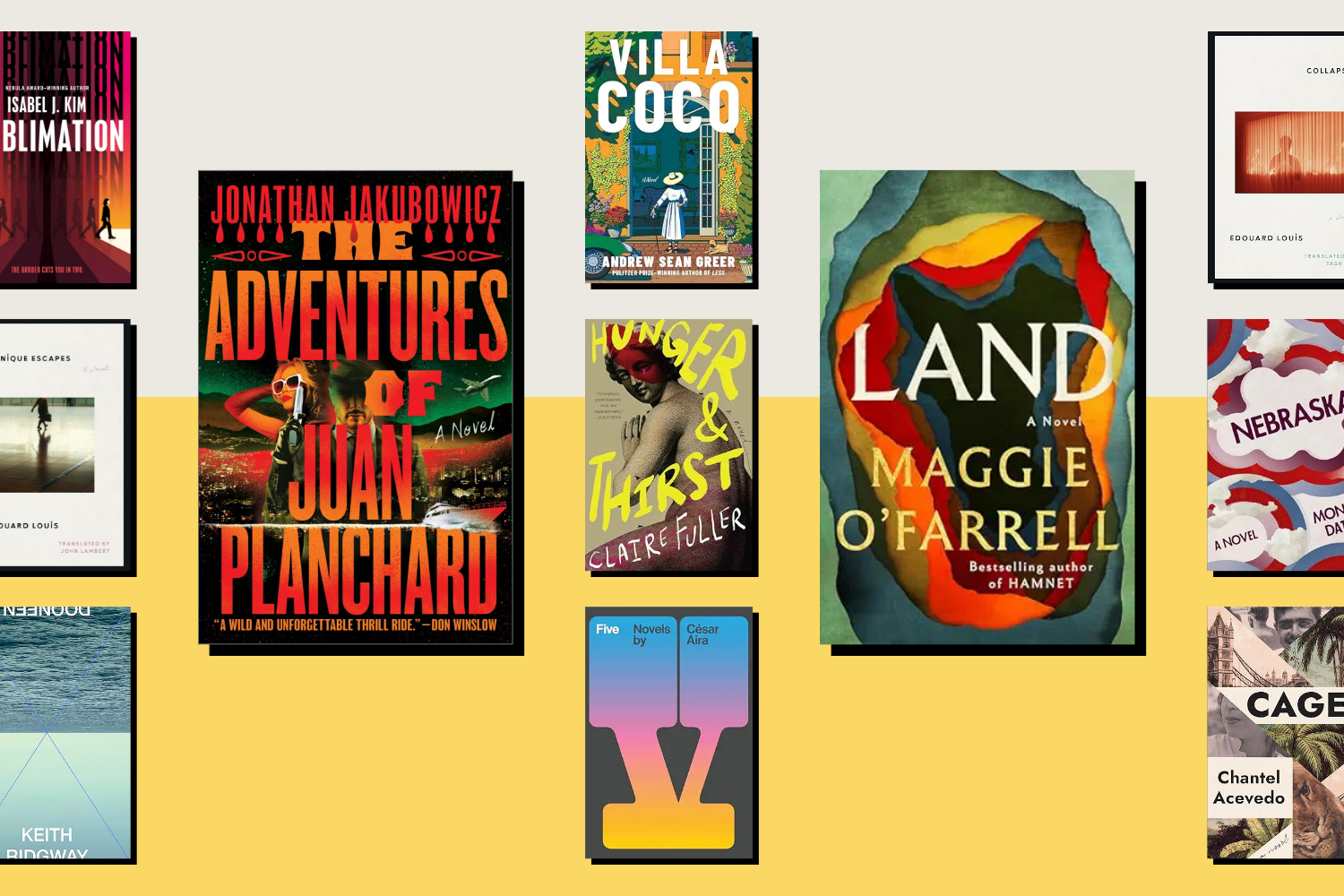
This month, we’re reading two novels that wrestle with troubling episodes of political history in Ireland and Venezuela.
Land: A Novel
Maggie O’Farrell (Knopf, 400 pp., $32, June 2026)

Maggie O’Farrell hardly needs an introduction after the extraordinary success of her 2020 novel, Hamnet. But if that book is known for its specificity, its ability to imagine the minutiae of William Shakespeare’s family life, her latest novel turns its focus outward, using one family to tell the tale of an entire nation. Land, by far O’Farrell’s most ambitious work, is an epic of Ireland, one that spans continents and millennia, all while remaining deeply rooted in one plot of earth on an unnamed Irish peninsula.
The core of the novel takes place after the Great Famine of the 1840s, which killed around 1 million Irish people and led more than 2 million more to emigrate. Tomás, who survived those years, has been hired as a cartographer by the “redcoats” to help complete Britain’s Ordnance Survey of 1865. His role is “to distil into inked symbols and ordered lines what has taken place here since the first maps were drawn.” His young son is his apprentice, and after an alarming encounter at a well in an ancient wood, he moves his entire family from Dublin to a homestead in the remote valley, scarred from the famine, where the pair carried out their mapping.
Yet Land also seems to touch nearly all of Ireland’s history and national lore: its colonization by the British, the mass exodus, the loss of Gaelic, Christianization, folk music, and its transformation into an agrarian society. (Only around 11 percent of Ireland remains forested, the third-lowest amount in the European Union.) At times, the novel reads almost like a medieval chronicle, as it moves across time, crop seasons, and invasions. In O’Farrell’s omniscient narration, we get the perspectives of not just family members and ancestors, but faraway figures and even objects: a skylark; a Roman general who chooses not to invade; and Tomás’s house itself, which can feel astonishment, even hold its breath. O’Farrell herself recently described a “pagan animism” running through the text.
Perhaps O’Farrell’s greatest feat with Land is her attunement to both the intricacies of human lives and the broader sweep of nationhood. It is, after all, a deeply personal story to O’Farrell, whose own great-great-grandfather was a cartographer for the Ordnance Survey. One can’t help but admire, too, the artistry of her prose, even as the book occasionally tips into overexplaining its themes. (Early on, the mapmaker has an anticolonial revelation: “I will do their bidding no more,” he declares. “I will never again cede to their version of geography, of history, of linguistics and toponomy.”)
When Tomás was a boy, nearly succumbing to hunger, he “discovered, to his faint surprise, that there was within him an inexplicable but strong urge to survive. It gushed through his veins, lit up the branched tangles of his brain. … He would not be going under, it told him.” What better figure to represent a nation of survival and resistance, of the unrelenting push for self-determination.—Chloe Hadavas
The Adventures of Juan Planchard: A Novel
Jonathan Jakubowicz (Grand Central Publishing, 288 pp., $29, June 2026)

Like many books published in authoritarian contexts, The Adventures of Juan Planchard is significant not only for its literary merit but also for its reception. Acclaimed filmmaker Jonathan Jakubowicz—who has been based in Los Angeles for two decades and describes himself as “the first [Venezuelan] artist forced into exile”—published this raunchy thriller in Spanish 10 years ago. It climbed bestseller lists and earned the ire of Venezuelan President Nicolás Maduro, who banned it from bookstores across the country.
Maduro’s censorship efforts were largely unsuccessful, and copies of The Adventures of Juan Planchard became a coveted form of contraband in Caracas. The novel “struck a nerve with a generation disillusioned by dictatorship and became a symbol of cultural resistance,” Jakubowicz writes in an author’s note accompanying a new English translation out this month.
The Adventures of Juan Planchard is set in 2011, in the waning days of Hugo Chávez’s rule. Pro-government tycoon Juan Planchard jets between Caracas, Las Vegas, Los Angeles, Madrid, Miami, and New York, spending most of his time snorting cocaine, sleeping with prostitutes, and making shady deals with Chinese businessmen. Jakubowicz details Juan’s escapades in such vulgar, almost pornographic prose that it cannot be quoted in this magazine. One chapter is simply titled “GADDAFI’S ASS.” (“I knew that if I packed in enough sex and violence, [the book] might just go viral,” Jakubowicz writes.)
Juan is a pragmatic Bolivarian revolutionary. Raised by middle-class parents who back Venezuela’s opposition—and resent their son’s ties to Chávez—he ditched a stable corporate career to get rich off state corruption. (“If the game is rigged for hustlers, then hustle,” Juan says of survival in his “poor, rich country.”) Privately, he is critical of Venezuela’s insecurity and lack of due process. But he also understands socialism’s appeal, particularly to the poor, and—despite owning property in several U.S. cities—takes every opportunity to critique “the Empire.”
In 2011, Juan hits several personal and professional roadblocks. Chávez is diagnosed with cancer, and some in Caracas’ elite are “afraid the party was ending.” The year “felt like one defeat after another” for global socialism, Juan says, adding, “In the span of a few months, we’d lost not only Gaddafi, but El Mono Jojoy, Osama bin Laden, and Kim Jong-il.” Juan also falls in love with Scarlet, a 21-year-old student at the University of California, Los Angeles, who challenges his swindler lifestyle. And, most importantly to the book’s plot, his parents become victims of the Chavista state apparatus, making Juan a “revolutionary devoured by the very chaos he once sanctified.”
Although The Adventures of Juan Planchard is a work of fiction, Jakubowicz appears to skewer several real-life figures. In addition to Chávez, Juan deals with a character named Vera Góldiger—an American woman who works for Chávez and is almost certainly a reference to Eva Golinger. Juan and Scarlet party on a yacht belonging to a “Fire-Breathing Deputy,” who may be Delcy Rodríguez or another woman high up in the Chavista ranks.
The book feels oddly prescient in other ways, too. In pondering what Cuba might look like if its benefactor Chávez were to fall, Juan says: “The Castros survived without the Soviets, and they’ll survive without us, even if it means watching their entire island starve to death.” Jakubowicz could not have known that the English translation of his novel would be published months after the U.S. ouster of Maduro and amid a hunger crisis in Cuba fueled by an intensified U.S. blockade of the island.
As much as The Adventures of Juan Planchard deals with Venezuela, it is equally about the United States. In one crasser passage, Juan says: “Miami’s the promised land for Latin American elites, but to actual Americans, Florida is full of fat, uneducated rednecks.” Juan has a love-hate relationship with the United States that ultimately morphs into exasperated resignation about U.S. hegemony. “The gringos, man! Whatever you do, they always end up with your money, your oil, your banks, your friends, your country, your dreams… your life,” Juan says at the story’s end.—Allison Meakem
June Releases, In Brief
Amitav Ghosh returns to speculative fiction with Ghost-Eye, a climate novel set across 1960s Calcutta and modern-day New York. In Claire Fuller’s Hunger and Thirst, a documentarian unearths a London sculptor’s (literally) haunted past. César Aira’s Five, translated by Chris Andrews, brings a quintet of the Argentine writer’s novellas to the English market. Keith Ridgway reimagines his hometown of Dublin in the dreamlike Dooneen. In Andrew Sean Greer’s Villa Coco, a young Brit finds himself swept up into the world of a Tuscan baroness.
An American has-been finds himself at the heart of a Bollywood murder mystery in crime mastermind Abir Mukherjee’s The Pinnacle. Chantel Acevedo’s Cages pieces together the fraught story of one man’s life across Havana, London, and Miami. A pair of buzzy novels by Édouard Louis—Collapse and Monique Escapes—are translated from French by Tash Aw and John Lambert, respectively. Tragedy, psychoanalysis, and the sweep of 20th-century history converge in Monica Datta’s Nebraska. And Isabel J. Kim’s debut novel Sublimation asks: What if international borders cut migrants into two?—Chloe Hadavas