
Instead, they share stories of being able to find their ground, setting up successful small businesses with the help of the International Committee of the Red Cross (ICRC), providing for their families, paying off debt, reinvesting in their businesses for sustainability and even creating employment opportunities for others suffering from the impact of conflict.
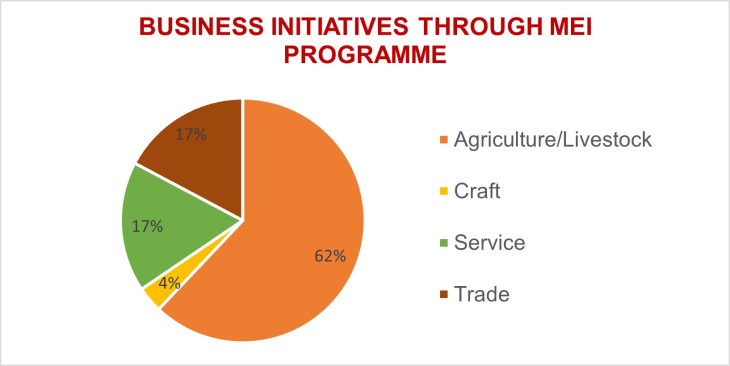
The three are among a group of 29 families from the Balkh and Kunduz provinces selected to be part of a microeconomic initiative programme of the ICRC in the region. The project has positively impacted 232 people between October and December 2023. According to statistics, women who were part of the programme could earn an average of AFN 7,867 (USD 110) a month, while men have been able to earn about AFN 10,282 (USD 143).
Sayed Reza
The 37-year-old resident of Balkh Province, a father of four, has a success story that began with a tragic event. “About a year-and-a-half ago, my son was injured in an explosion. The ICRC gave us a cash grant to cope with the immediate financial consequences of the incident. Later we learned of the microeconomic initiatives programme to help victims regain a sustainable income. Through the programme I was trained in starting and managing a small business and then given a grant of 1,700 US dollars (AFN 121,550) to establish my own welding business,” he says.
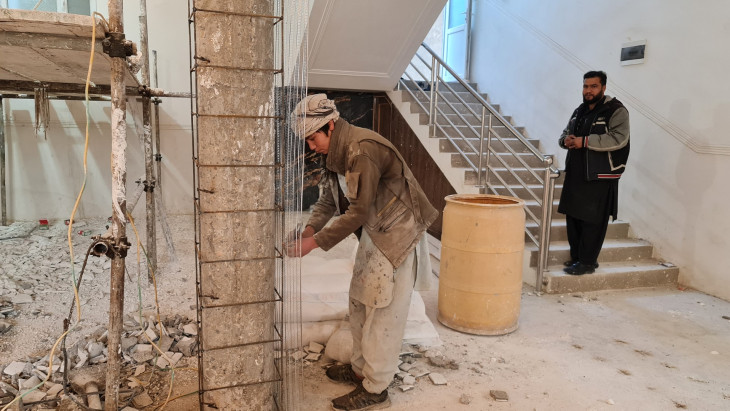
Sayed Reza (right) oversees the work done by his employee for a project that he was recently given in Mazar-i-Sharif city of Balkh Province. (PHOTO: ICRC/Zabihullah BARMAK)
Reza knows that his journey from hardship to financial stability is inspiring and he is eager to help others around him. “Providing for my family was a constant struggle before I started the business. Now, I earn an average income of AFN 15,000 (USD 210) a month. I have also been able to create job opportunities for eight workers in Kunduz and Balkh provinces, helping them support their families too,” he says proudly. But financial stability is only one measure of success for Reza. “I am able to send my children to a reputable private school. That fills me with immense joy. Also, securing four sizeable projects has given me a sense of accomplishment and security about the future,” he says.
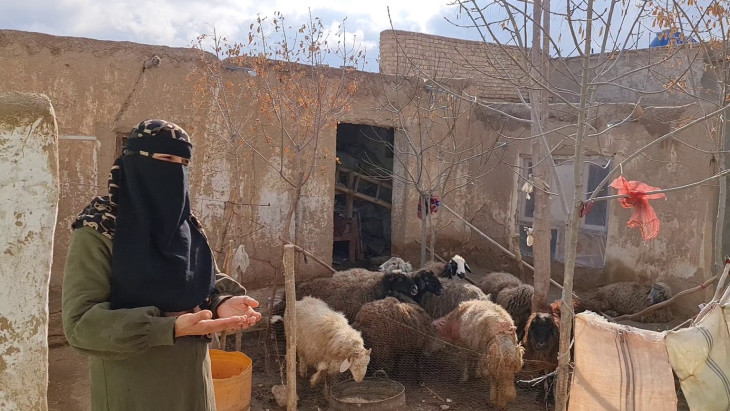
Muzhda Ahmadi has a small livestock farm in Mazar-i-Sharif city of Balkh Province. (PHOTO: ICRC/Zabihullah BARMAK)
Muzhda Ahmadi
In 2021, 30-year-old Ahmadi lost her husband amid armed conflict and found herself solely responsible for the well-being of her five children. “The journey has been difficult and I struggled to provide for my children. However, starting the livestock business with the ICRC’s help has been transformative,” she says. Ahmadi took the entrepreneurial leap with the help of a USD 1,450 (AFN 103,675) grant from the ICRC and has since expanded her livestock business to include a healthy flock of 11 sheep. “When the lambs are ready to be sold, I will be able to invest in my children’s education so that they don’t have to endure the hardships I have faced,” she says.
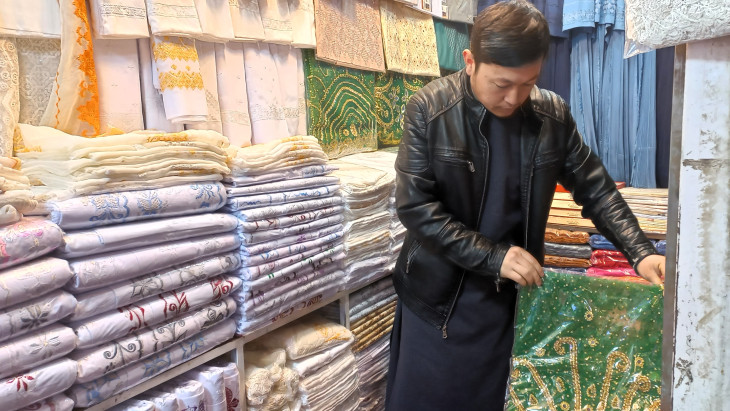
Abdullah Amiri at the embroidery shop he set up in Balkh Province with the ICRC’s help. (PHOTO: ICRC)
Abdullah Amiri
An explosion in their fast-food shop caused head and leg injuries to Amiri’s father and became a life altering incident for the family. Struggling to cope with the financial impact of the incident, 29-year-old Amiri contacted the ICRC and initially received a cash grant to meet their basic needs.
“Later, the microeconomic programme became a beacon of hope for me. I was skilled in embroidery and had harboured a dream of starting my own business one day. The ICRC gave me USD 1,500 (AFN 107,250) to start a business and I put in USD 1,000 (AFN 71,500) more from my side to set up a shop and a small workshop,” he shares. Business took off and Amiri hired eight people, including six women, to work for him. He is now looking to expand his business to three more districts.
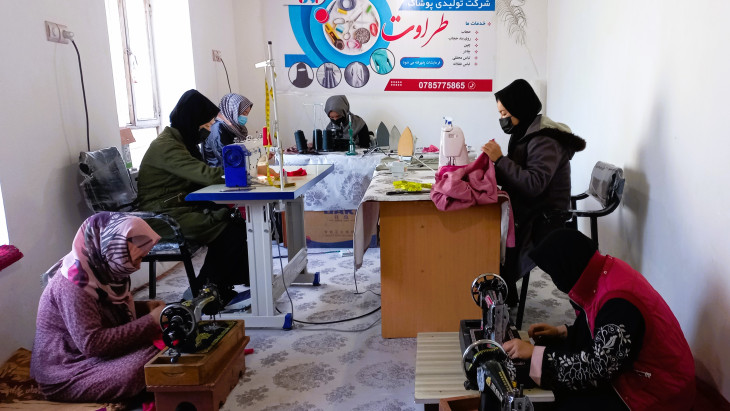
Samargul Muhammadi (sitting under the poster) is able to stitch more clothes and earn more by working at the workshop started by Abdullah Amiri. (PHOTO: ICRC)
Samargul Muhammadi, one of the six women employed by Amiri, says working at the workshop has been pivotal for her life too. “At the workshop I can produce a greater volume of items, which in turn increases my earnings. This has helped me to comfortably provide for my family’s needs and invest in my brother’s education,” she says.
A project to facilitate sustainable income
A comprehensive economic assessment was conducted in Kunduz Province and Mazar-i-Sharif city, Chimtal, Dehdadi, Charbolak districts of Balkh Province between May and June 2023 before identifying 29 vulnerable families, including six households led by women. The evaluation gauged various socio-economic factors such as existing skills, market knowledge, level of enthusiasm, educational background, potential risks and viability of proposed business ideas. The financial assistance was disbursed in two phases – 60% in the first phase and then 40% – to ensure the successful execution of each business plan and prevent misuse.
Talking about the wider impact of the initiative, ICRC staff member in Mazar-i-Sharif subdelegation Ekramuddin Amiri says, “While our core aim was to facilitate a sustainable income source for those who have suffered from violence and incidents of weapon contamination, we witnessed a ripple effect as many became catalysts for job creation within their communities. This has increased the visibility of their businesses and strengthened the value chain, particularly for those involved in the dairy sector. Additionally, it has promoted adaptive work models, like shift scheduling, especially for those in the service industry including transportation. Above all, the families who were among the most vulnerable because of the consequences of conflict have been able to regain their dignity.”
BOX:
Other initiatives in 2023 to build economic security:
- 10,446 families (83,568 people) received multipurpose cash assistance in Ghazni, Helmand, Herat, Farah, Kandahar, Kunar, Nangarhar, Kunduz, Samangan, Faryab, Jawzjan and Panjshir provinces to meet their basic needs.
- 2,467 families (19,736 people) earned income through cash-for-work projects such as repair of irrigation canals in Laghman, Farah, Khost, Kandahar, Helmand, Panjshir, Baghlan, Balkh, Herat and Nangarhar provinces.
- 2,498 families (19,984 people) who depend on agriculture in Herat and Farah provinces received cash grants to prepare their land and buy agricultural supplies.
- 300 farmers (2,400 individuals) in Farah and Kapisa benefited from training in resource management and orchard farming respectively. In Kapisa, orchard famers additionally received kits to maintain their gardens.
- 907 pregnant and lactating women at higher risk of malnutrition received nutrition education and cash grants to access diverse food in Kandahar.
- 360 households (3,396 people) who suffered violence or were victims of incidents of weapon contamination received assistance to cope with the financial consequences.