
Former 英 Prime Minister Cameron’s keynote address
“We must be wary of optimistic bias that we will return to the past”
Emphasis on “solidarity of values” through the solution
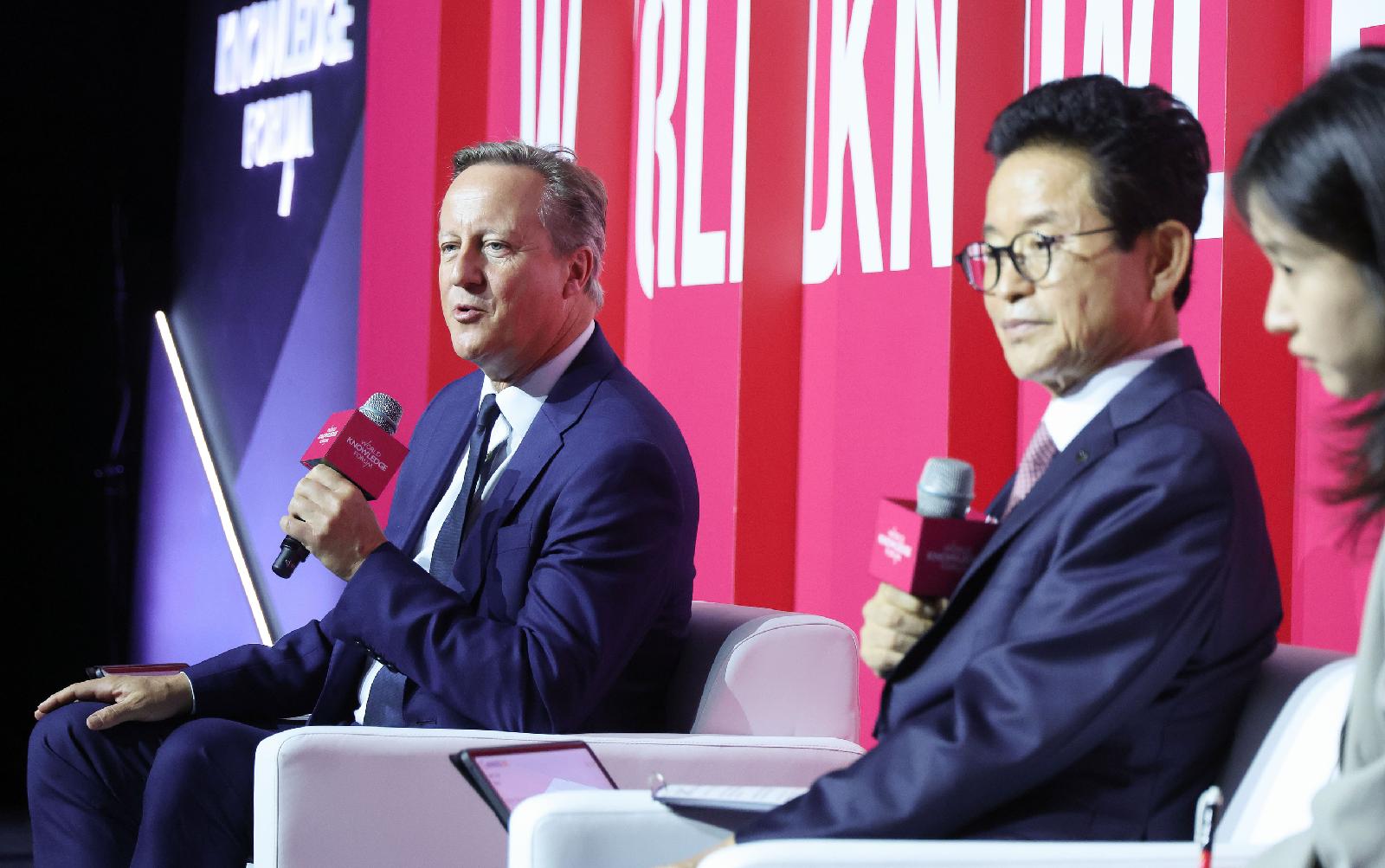
![Former British Prime Minister David Cameron (left) and North Gyeongsang Province Governor Lee Chul-woo are bold at the 27th World Knowledge Forum 'Leadership, Soft Power, and the Way of the Nation' held at the Shilla Hotel in Jung-gu, Seoul on the 8th. [Reporter Lee Seung Hwan]](https://wimg.mk.co.kr/news/cms/202609/08/news-p.v1.20260908.a763f14aa0734d85a9df0367cb61e3c6_P1.jpg)
As geopolitical risks protrude frequently, the global economy is still unable to return to normal. In addition, while artificial intelligence (AI) technology is developing at a faster pace than expected, major countries are sticking to their own priority policies and shaking the alliance structure.
Global leaders who gathered in Seoul to attend the 27th World Knowledge Forum hosted by Maekyung Media on the 8th presented “cold reality awareness” and “value solidarity” as keywords to escape the crisis. Now is the urgent order to make an active compromise based on communication.
Former British Prime Minister David Cameron emphasized in his opening keynote speech that “all policies should be focused on economic and national security,” adding, “We should work with countries that share values, not just interests.” He cited democracy, the rule of law, and the market economy as the shared values underlying cooperation.
Former Prime Minister Cameron diagnosed that the alternative lies in a “value-based alliance” at a time when international organizations, including the United Nations, are not doing their part. “To clear away huge obstacles, including the situation in the Gulf region, the South China Sea, Kyiv and Tel Aviv, we need a course change, not a revolution,” he said. “To do this, we need bold determination and political skills accordingly, and in the present era, even the world’s strongest power still needs alliances.”
![Former British Prime Minister David Cameron (left) speaks at the 27th World Knowledge Forum 'Leadership, Soft Power, and the Way of the Nation' session held at the Shilla Hotel in Jung-gu, Seoul on the 8th. [Reporter Lee Seung Hwan]](https://wimg.mk.co.kr/news/cms/202609/08/news-p.v1.20260908.7365dd43f6c743638dd8b196bdd45a48_P1.jpg)
Former Prime Minister Cameron pointed to domestic politics leaning on populism as the reason why countries around the world are shaking. In particular, the United States and Europe pointed out that the immigration issue has shaken their national identity, hindering the establishment of correct policies. Former Prime Minister Cameron appealed, “We should be wary of the ‘optimism bias’ that everything can go back to the past like a miracle and be based on cool realism.”
Former Danish Prime Minister Helle Thorning-Schmidt also emphasized “value solidarity” between liberal democracies. “We must cherish democracy, freedom, prosperity, global trade, being a member of the international community, and working together to create a better world,” he said.
Some advised that “realistic diplomacy” is the direction for South Korea to move forward. This means that a strategy is needed to participate in value solidarity but not turn either side into an enemy. It is explained that it is a possible strategy when a country has an advantage in various aspects such as economy, technology, and culture.
“Korea is a world-class economic and technological powerhouse and a civilized country,” said Pepe Escobar, a Brazilian journalist and author of The Coming of a Multipolar World. “There are only a few countries in the world that meet all these conditions.” In other words, South Korea has enough capacity to secure its own diplomatic space worthy of its international status.