
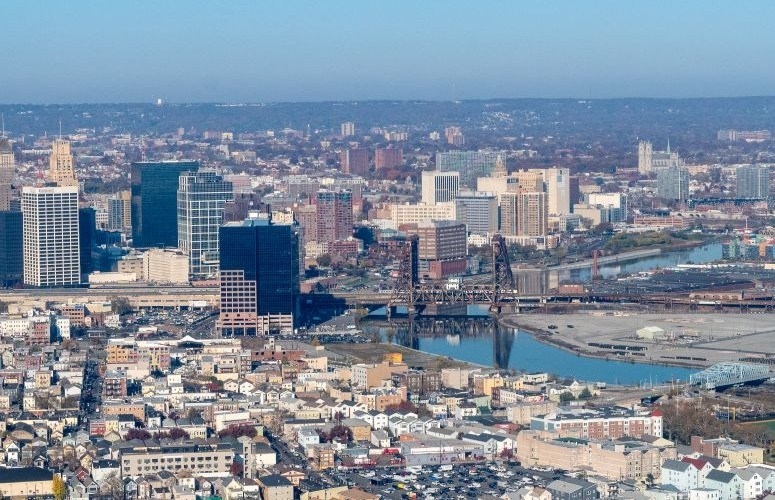
The Newark skyline
America @ 250
By CREDA NJ On Jul 23, 2026
Long before New Jersey became a leading national distribution hub and home to sprawling corporate campuses, its commercial real estate story began the 20th century on factory floors and in crowded downtown office buildings as manufacturing, retail and wholesale trade, banking, and services grew across the state. Trenton was a thriving industrial city with major pottery, ceramics, steel, and other interests.
Industries that would grow to define the state’s economic drivers – and fuel its commercial real estate market – were already established or taking root. Johnson & Johnson, founded in New Brunswick in 1886, served as the cornerstone for the Garden State’s sustained identity as “The Medicine Chest of the Nation.” Through 1930, Thomas Edison’s Invention Factory for decades served as a hub of innovation, establishing the state’s R&D legacy. And in the 1940s, Bell Labs established its research campus in Murray Hill, anchoring New Jersey as a magnet for telecommunications.
The Postwar Boom: Roads Open a New Market
Accessibility has always been a key advantage for New Jersey. The Garden State Parkway, constructed between 1946 and 1957, and the New Jersey Turnpike, opened in 1952, connected a state that had always benefitted from its geography between New York and Philadelphia. By 1957, New Jersey had more than 15,000 major industrial establishments. The population grew and real estate values soared, and the era of suburban commercial development was underway.
The 1960s saw manufacturing and industrial jobs starting to decline, and state government agencies began leasing office space in Trenton and the surrounding suburbs. Cali Associates (which would become Mack-Cali) built its first office building in Cranford. Hartz Mountain ventured beyond its successful pet care business into real estate development with a large distribution facility in Bayonne. The Hackensack Meadowlands Development Commission was created in 1969, laying the groundwork for one of the state’s most consequential development corridors.
The 1970s: NAIOP and the Development Boom
It was in 1970 that David Steiner and Frank Visceglia Sr. sat down for a lunch meeting that gave birth to the New Jersey chapter of NAIOP (now CREDA), uniting all facets of the state’s non-residential development sector to advocate for pro-growth public policies. Their timing proved prophetic: the 1970s and 1980s would see millions of square feet of commercial real estate development across the state.
In this decade, New Jersey led the nation in the production of chemicals and pharmaceuticals. Further, demand for corporate headquarters and regional operations by a range of sectors – notably including financial, insurance and professional services – fueled sustained office space demand.
The 1980s: The Cubicle Decade and the Rise of 8A
The 1980s brought the “cubicle farm” and continued expansion of the Garden State office market and simultaneously ignited industrial development at New Jersey Turnpike Exit 8A. Between 1982 and 1992, Trenton alone saw more than a dozen office buildings constructed primarily to house state offices. With the first industrial product at 8A, Matrix Development Group pioneered what would become the nation’s most strategically positioned distribution submarket, a midpoint on the Boston to Washington, D.C. corridor, with direct seaport and airport access. At the same time, New Urban Enterprise Zone incentives led to the construction of numerous malls and big-box retailers.
The 1990s: Urban Challenges, Suburban Resilience
The 1990s challenged New Jersey’s cities. Urban property values softened while suburban and rural markets continued to climb. As manufacturing jobs continued to migrate, the concentration of pharmaceutical headquarters along the Route 1 and I-287 corridors and telecom firms in north Jersey provided a stabilizing counterweight. By the end of the decade, a booming national economy and New Jersey’s concentration of skilled and specialized labor set the stage for a commercial rebound. Cities like Perth Amboy welcomed hundreds of millions of dollars in new housing and retail development on former industrial sites.
The 2000s: Industrial Ascent and the Digital Edge
The new century underscored New Jersey’s irreplaceable location advantage. Increased shipments into Ports Newark and Elizabeth drove industrial development; by 2002, the market had grown to one of the nation’s largest, at upwards of 750 million square feet of inventory. Approximately 4 million square feet of industrial space was completed that year, 75% of it in the New Brunswick/ Piscataway submarket. New Jersey also continued its dominance in other areas. By 2008, northern New Jersey ranked as the ninth largest market for co-location and data center services in the United States, and first in broadband telecommunications and broadband penetration.
The 2010s: Sustainability, Superstorm Sandy, and Shifting Demand
Through the 2010s, flexible workspaces were in demand as corporate cultures evolved. Post-Superstorm Sandy, office tenants wanted the security of duplicated systems, back-up generators, and even redundant utility feeds. Interest in “green” and sustainable buildings and workspaces was on the rise. As the decade closed, New Jersey had 83 LEED certified buildings, and the new Meadowlands stadium was termed “the greenest stadium in the country.” Changes in materials handling and logistics created demand for modernized warehouses that could accommodate more employees, higher ceilings for vertical racking and more finished office space.
The 2020s: Disruption as Catalyst
Although the term “telecommute” was coined back in 1972, only a fraction of the labor force worked remotely until the COVID-19 Pandemic changed everything. Almost overnight, the way people thought about space was fundamentally reimagined, and New Jersey’s commercial real estate community responded with the creativity and resolve that has always defined it. Industrial demand surged, adaptive reuse accelerated, and developers found opportunity where others saw uncertainty.
The years that have followed prove what New Jersey’s commercial real estate industry has always known: disruption creates opportunity. Modern, Class A industrial product has been created to meet sustained demand; the sector logged nearly 25 million square feet in leasing activity in 2025 alone. Obsolete industrial and office properties are being reimagined as mixed-use communities, life sciences campuses, and transit-oriented developments across the state. That is breathing new life into corridors that earlier generations of developers first made viable. Urban centers that struggled for decades are drawing investment, population growth, and an entirely new generation of tenants.
As we move deeper into the 2020s, demographic shifts, globalization, the mobile economy, the imperative to capture and retain young talent, aging infrastructure and sustainable energy all are key influencers. These same factors are central public policy and investment decisions.
New Jersey’s commercial real estate story has never been a straight line. It has been shaped by policy, technology, demographics, and the ingenuity of the people who chose to build here through it all. But the thread running through every decade remains the same: when the market shifts, New Jersey’s development community shifts with it and finds a way forward.
Related Articles: